
The 3-5-2 Formation Explained: Roles, Strengths and Weaknesses
Three centre-backs, two wing-backs doing the work of four players, and a front two. How the 3-5-2 actually works, drawn out, and why it keeps coming back.
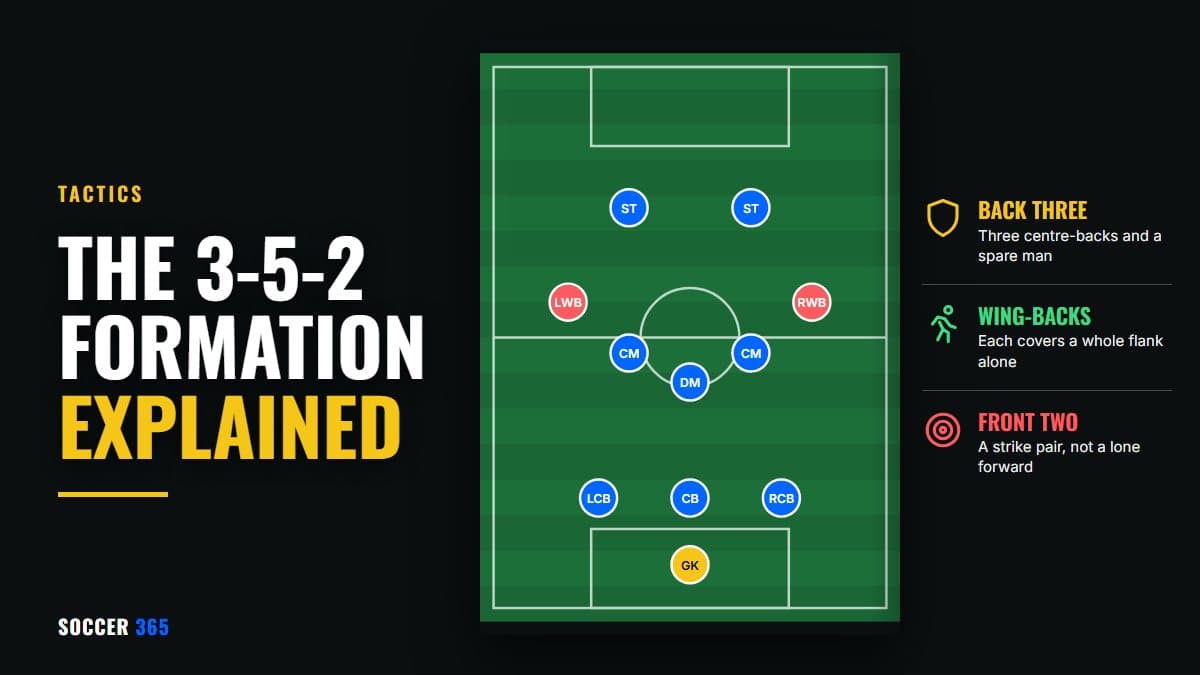
The 3-5-2 is a formation with three centre-backs, five midfielders and two strikers. Its defining players are the two wing-backs, who patrol an entire flank on their own. With the ball they push up and the team attacks with width; without it they drop into the back line and the shape becomes a 5-3-2.
That double life is the whole point of it. A 3-5-2 can look like one of the most attacking shapes in football in one phase and one of the most defensive in the next, with the same eleven players.
The shape, line by line
Read it from the back.
Three centre-backs. The middle one is usually the organiser and the best in the air. The two either side, the wide centre-backs, are the players who make the system work or fail: they defend wider areas than a centre-back in a back four, and in possession they are expected to step out with the ball, sometimes into midfield.
Two wing-backs. They are not full-backs and not wingers, but both. In possession they provide all of the team's natural width, because nobody else in the side stands on the touchline. Out of possession they drop level with the centre-backs. No position on the pitch covers more ground, which is why a 3-5-2 without fit, disciplined wing-backs is not really a 3-5-2 at all.
Three central midfielders. Most versions play one holder and two box-to-box or creative midfielders either side. The holder screens the back three and takes the ball from them; the other two carry it forward and arrive in the box. Having three in the middle is the formation's second big selling point: against a 4-4-2 or a 4-2-3-1, a 3-5-2 starts with a free player in central midfield.
Two strikers. A pair rather than a lone forward, so the centre-backs they face never get a spare man. The classic pairing is complementary: one who comes short to link play, one who runs in behind. Inter's Lautaro Martínez and Marcus Thuram are a textbook modern example.
How it changes without the ball
When possession is lost the wing-backs retreat and the 3-5-2 becomes a 5-3-2: five defenders across the width of the penalty area, three midfielders in front of them, two forwards left high.
That back five is very hard to play through. Crosses meet three centre-backs; an opponent's winger has a wing-back in front of him and a wide centre-back ready to step across. The cost is at the top of the pitch: with only two forwards and three midfielders in front of the ball, a team sitting in a 5-3-2 can struggle to win it back high, and has to go a long way to reach the other goal.
What each player is asked to do
| Position | With the ball | Without the ball |
|---|---|---|
| Goalkeeper | Short passes to the back three, often starts build-up | Sweeps behind a high line |
| Wide centre-backs | Carry the ball out, overlap the wing-back on occasion | Defend the channel between centre and flank |
| Central centre-back | Organises, plays the long diagonal switch | Marks the striker, wins the aerial ball |
| Wing-backs | Stay wide and high, cross, stretch the pitch | Drop into a back five, track the opposing winger |
| Holding midfielder | Receives from the back three, sets the tempo | Screens the centre-backs, protects the space in front of them |
| Other two midfielders | Carry the ball, arrive in the box, support the wing-backs | Shuffle across to cover the flank the ball is on |
| Strikers | One drops to link, one runs in behind | Press the centre-backs, cut passing lanes into midfield |
Strengths
Numbers in the middle. Three central midfielders against the two in a 4-4-2 or 4-2-3-1 gives a 3-5-2 an extra player where most games are decided.
A spare centre-back. Against a single striker, a back three always has one defender free to step into midfield or cover. Against two strikers, it still has a spare man in a way a back four does not.
Width without wingers. Two wing-backs deliver the width of a 4-3-3 while the front two stay central, close to goal. That lets a coach play two proper strikers without giving up wide threat.
A solid defensive block. The 5-3-2 is one of the easiest shapes to defend deep in. For sides that expect to spend long periods without the ball, that is a big part of the attraction.
Weaknesses
The space behind the wing-backs. If a wing-back is caught upfield when the ball is lost, the opposing winger or full-back can run straight at a wide centre-back in open space. Every serious plan against the 3-5-2 starts here.
Wing-back fatigue. Asking two players to cover a whole flank each is physically brutal. Coaches who play the system for long spells tend to rotate the position more than any other, and a tired wing-back is where the first weakness above appears.
Being pressed with three. A team that presses with three forwards can go man-for-man on the back three and make the build-up very uncomfortable. PSG's 5-0 win over Inter in the 2025 Champions League final was an extreme case: Inter lined up in their usual 3-5-2 and were pressed so aggressively deep in their own half that they rarely had time on the ball.
Thin wide areas in midfield. With the wing-backs as the only wide players, a team that overloads one flank with a full-back and a winger can create a two-against-one before a midfielder has time to shuffle across.
The teams that made it famous
Argentina, 1986. Carlos Bilardo's World Cup winners are the side most often credited with taking the 3-5-2 into the mainstream: a back three, wing-backs, and a midfield built to give Diego Maradona the freedom to decide games behind the strikers.
Antonio Conte's sides. Conte made the back three his signature at Juventus, used it with Italy at Euro 2016, and brought it to Inter, where his 3-5-2 won the 2020-21 Serie A title. At Chelsea he switched to a back three midway through his first season and won the 2016-17 Premier League with it, although that side more often lined up as a 3-4-3.
Simone Inzaghi's Inter. Inzaghi kept the 3-5-2 on taking over from Conte and refined it for four seasons: overlapping wide centre-backs, constant rotation between midfielders and wing-backs, and a strike partnership doing most of the scoring. It won the 2023-24 Scudetto and reached two Champions League finals, losing 1-0 to Manchester City in 2023 and 5-0 to PSG in 2025. When Cristian Chivu replaced him, Inter had been playing almost exclusively in a 3-5-2 for six seasons, and he chose to keep it.
3-5-2 against the other common shapes
| Opponent | Where the 3-5-2 has the edge | Where it is exposed |
|---|---|---|
| 4-4-2 | Three midfielders against two in the centre; a spare centre-back against two strikers | Opposing wingers and full-backs doubling up on a wing-back |
| 4-3-3 | Two strikers occupy the two centre-backs; wing-backs can pin the full-backs back | Three forwards pressing the back three man-for-man |
| 4-2-3-1 | Extra central midfielder can mark the No.10 without leaving a gap | Wide attackers of the 4-2-3-1 attacking the space behind the wing-backs |
| 3-5-2 (mirror) | Evenly matched in every zone | Games often turn into a series of individual duels |
When a coach picks it
A 3-5-2 makes most sense when a squad has more good centre-backs than good wingers, two strikers worth playing together, and wing-backs fit enough to run the flank all game. It is also a common choice for a side that expects to defend for long periods and wants a shape that becomes a back five without any substitutions.
It makes least sense against opponents who press high with three forwards and attack wide with a full-back and winger together, because that combination hits both of its structural weak points at once.
Because the wing-backs tire first, a 3-5-2 coach usually spends his changes there; the limits on how many he gets are set out in football substitution rules.
Frequently Asked Questions
What is a 3-5-2 formation?
A shape with three centre-backs, five midfielders and two strikers. The two widest midfielders are wing-backs who defend the full width of the pitch on their own, which is why the shape turns into a 5-3-2 when the team loses the ball.
Is the 3-5-2 attacking or defensive?
Neither by default. With the wing-backs pushed high it attacks with up to seven players; with them dropped it defends with five across the back. Which it becomes depends on the wing-backs and on how high the coach sets the back three.
What is the main weakness of the 3-5-2?
The space behind and beside the wing-backs. When they are caught upfield, an opponent's winger or full-back can run at a wide centre-back in a one-against-one, and a team pressing with three forwards can make it hard for the back three to build out.
Which teams are famous for playing 3-5-2?
Carlos Bilardo's Argentina at the 1986 World Cup, Antonio Conte's Juventus, Italy and Inter, and Simone Inzaghi's Inter, which reached the Champions League finals of 2023 and 2025 almost exclusively in the shape.
What is the difference between 3-5-2 and 3-4-3?
Both play three centre-backs and two wing-backs. The 3-5-2 uses three central midfielders and two strikers; the 3-4-3 uses two central midfielders and three forwards, trading control of the middle for width and pressing up front.
Do you need special players to play 3-5-2?
Mainly two: wing-backs with the stamina to cover the whole flank for ninety minutes, and at least one wide centre-back comfortable carrying the ball and defending in open space. Without those, the shape is hard to sustain.