Premier League Squad Rules: The 25-Man List and Homegrown Quota
Twenty-five names, a maximum of 17 non-homegrown, and unlimited under-21s. How the Premier League squad list works and why good players get left off it.
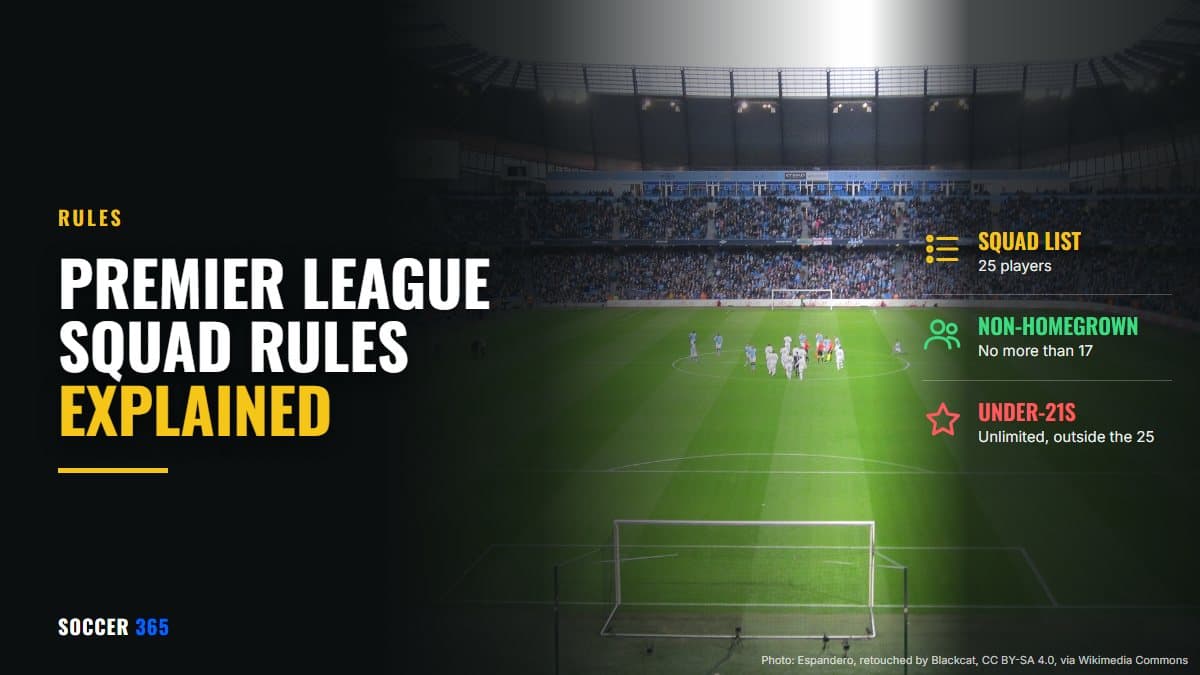
A Premier League club registers a squad list of 25 players, and no more than 17 of them may be non-homegrown. The remaining places have to go to homegrown players. Under-21s do not count against the 25 at all.
That single constraint shapes more transfer business than most people realise, and it explains the annual sight of an expensive signing being left off the list entirely.
The three numbers
| Squad list size | 25 |
| Maximum non-homegrown | 17 |
| Under-21 players | Unlimited, over and above the 25 |
The Premier League puts the restriction plainly: a squad "can contain no more than 17 players who do not fulfil 'Home Grown Player' criteria."
Note what that does not say. It does not require a club to name eight homegrown players. A club with only fourteen qualifying non-homegrown players and no homegrown ones at all can register a squad of fourteen. The 17 is a ceiling on one category, not a quota to be filled. In practice clubs want the full 25, so the eight places become a target by arithmetic rather than by rule.
What "homegrown" actually means
This is the part almost everyone gets wrong, and it is worth reading slowly.
A homegrown player is one who, irrespective of nationality or age, has been registered with any club affiliated to the Football Association or the Football Association of Wales for three entire seasons, or 36 months, before his 21st birthday.
Three consequences follow, and none of them are intuitive:
Nationality is irrelevant. A Spanish player who joined an English academy at 16 and stayed three seasons is homegrown. The rule is about where you were developed, not what passport you hold.
It does not have to be your current club. Registration at any affiliated club counts. A player developed at one academy and sold twice still carries homegrown status with him.
An England international can fail the test. A player who spent his teenage years at a club abroad and arrived in England at 22 is not homegrown, however many caps he wins later. Nothing he does after 21 can change it.
Why under-21s are free
Young players are eligible over and above the 25, which is the release valve in the whole system.
Without it, a club developing six promising nineteen-year-olds would have to choose between blocking six squad places or loaning them all out. With it, an academy graduate can sit on the bench all season, come on in the ninetieth minute, and cost his club nothing in registration terms.
This is one of the quieter reasons English clubs invest so heavily in academies. Homegrown status is worth something in its own right, and before a player turns 21 he is worth something and free. For the financial side of the same incentive, and why an academy sale lands differently in the accounts than any other sale, see why clubs sell academy players.
When the list is set, and why that traps clubs
Squad lists are submitted after each transfer window closes, and changes may be made during a window.
The consequence is that the list is frozen between windows. A club that loses two centre-backs to injury in October cannot promote a 23-year-old reserve onto the list to cover, because he is over 21 and the window is shut. He can train all he likes; he cannot be added.
This is why you occasionally see a club fielding an obviously unbalanced side in December, and why deadline-day business sometimes looks defensive rather than ambitious. A manager is not only buying for the team he wants, he is insuring the list he is stuck with. The mechanics of those windows are covered in how transfer windows work.
What it looks like when it bites
The visible symptom is a squad list published with fewer than 25 names on it, or a well-paid senior signing simply absent from it.
Both happen for the same reason: the club has run out of non-homegrown places. If seventeen of your best players do not qualify as homegrown, the eighteenth cannot be registered no matter what he cost or what he earns. He trains, he plays in cup competitions where different rules may apply, and he waits for January.
That is also why homegrown players with modest ability are sometimes retained on contracts that look generous. They are not being paid only for what they do on the pitch. They are being paid for occupying a place that a club would otherwise be unable to use.
Frequently Asked Questions
How many players are in a Premier League squad?
Twenty-five, submitted as a squad list after each transfer window closes. Under-21 players are eligible over and above that limit, so the true squad is usually larger.
What is a homegrown player in the Premier League?
A player who, regardless of nationality or age, has been registered with a club affiliated to the FA or the Football Association of Wales for three entire seasons, or 36 months, before his 21st birthday.
How many non-homegrown players can a Premier League club have?
No more than 17 of the 25 places may go to players who do not meet the homegrown criteria.
Does a homegrown player have to be English?
No. Nationality is irrelevant. A player who moved to England at 16 and spent three seasons registered at an English club qualifies; an England international who came through abroad may not.
Do under-21 players count against the 25?
No. They are eligible over and above the limit, which is why clubs can carry large numbers of young players without using squad places.
Can a squad list be changed mid-season?
Changes may be made during a transfer window. Outside a window the list is fixed, which is why an injury in October cannot be covered by promoting someone onto it.