Why Do Transfers Collapse at the Last Minute? 6 Reasons
Medicals, agent fees and clause disputes: the six reasons a done deal falls apart before it's signed, and why they surface so late.
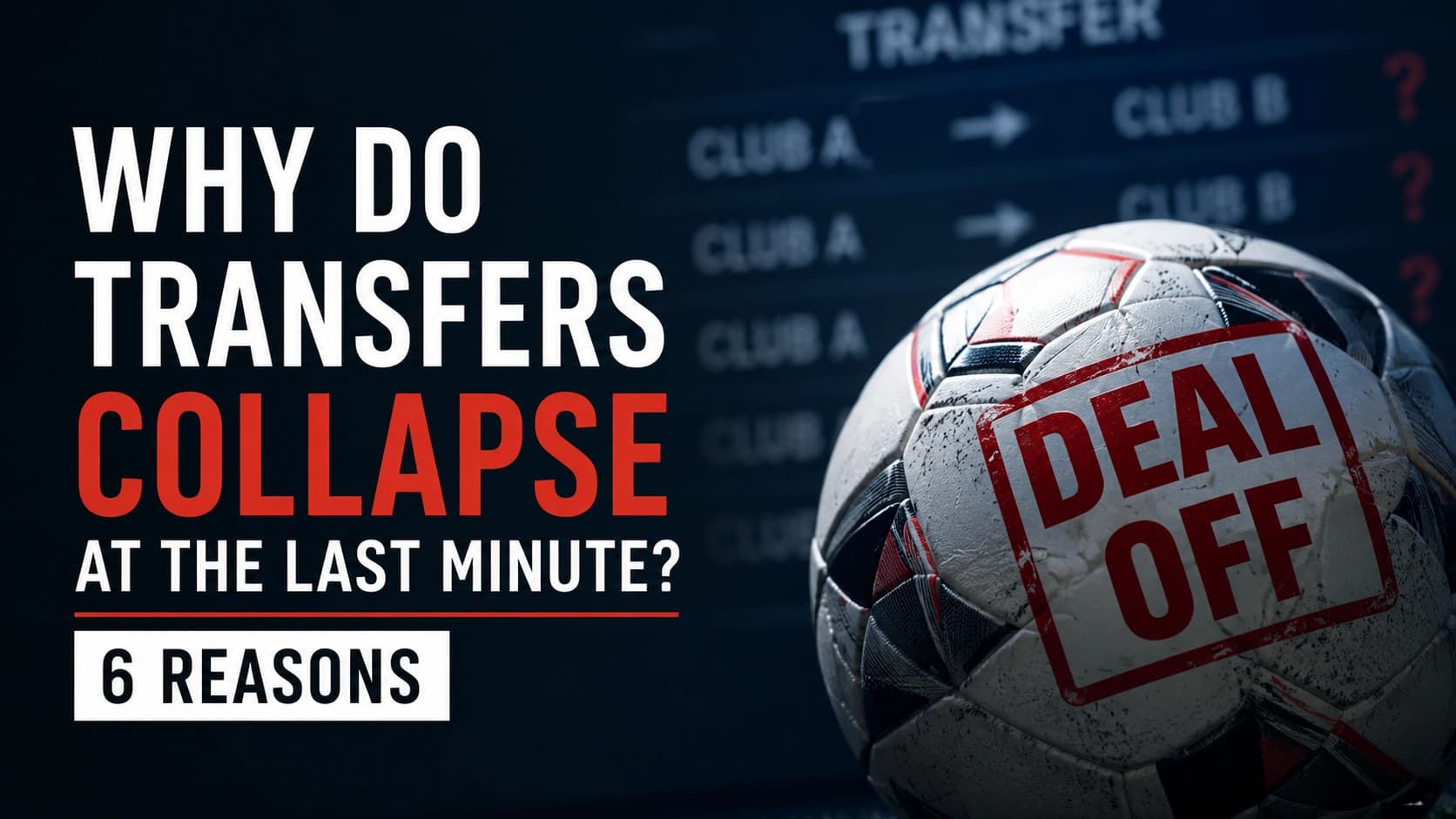
Transfer deadline day is full of deals that look certain right up until they fail. A move can be all but announced one hour and dead the next.
The reasons repeat. Here are the six that account for most collapses, and why they cluster in the last hours of a window rather than being spotted weeks earlier.
1. Failed medicals
Clubs run a full medical before confirming any signing: scans, cardiac screening, physical testing, and a review of the player's injury history.
The examination can surface an old problem that never healed properly, a joint that won't tolerate the workload, or a fresh issue nobody knew about. Occasionally it finds something with implications well beyond football.
The reason this lands so late is procedural. A medical costs money and requires the player to travel, so nobody schedules one until a fee and personal terms are close to settled. That pushes it into the final stretch by design — which means a bad result arrives when there's no time left to do anything about it.
A failed medical doesn't always kill the deal outright. The common response is to restructure: a shorter contract, a lower guaranteed fee with more in appearance-based add-ons, or wages weighted towards games played. A deal "collapsing over the medical" often means the two sides couldn't agree on how to reprice the risk.
2. Personal terms
Two clubs agreeing a fee settles only half the transaction. The player then has to agree his own contract with the buying club, and that's a separate negotiation with a different counterparty.
What gets argued over:
- Salary, and how much of it is guaranteed versus performance-linked
- Contract length, which matters enormously to a player over 30
- Signing-on fees, paid in instalments across the contract
- Bonuses — appearances, goals, qualification, trophies
- Image rights, which for a marketable player can rival the salary
- Release clauses, so he isn't trapped if the project fails. See our guide to release clauses.
A player who doesn't really want the move can also use personal terms as a polite exit. Rather than refusing outright, he asks for terms he knows won't be met, and the deal dies without anyone having to say no in public.
3. Agent fees
This is the reason least covered and most underestimated. Commission is a real, substantial line item, and it's frequently the last thing negotiated.
An agent's fee has to come from somewhere: the player's wages, the buying club's budget, or the selling club's proceeds. When a club has already stretched to fund the fee and the salary, it may simply refuse the commission being demanded — and the agent, who has no obligation to deliver a deal that doesn't pay him, walks.
Deals can also stall over who is being paid rather than how much, particularly where more than one intermediary claims to have brokered the move. Our guide to how football agents get paid sets out how the commission structures work.
4. The structure of the fee, and the clauses attached
Clubs walk away over how a fee is built far more often than over the headline number.
- Payment schedule. 40 million across four years is a completely different proposition to 40 million now. A selling club needing cash this season may reject the larger total.
- Add-ons. Whether appearance and trophy bonuses are realistic or deliberately unreachable.
- Sell-on clauses. What percentage of a future resale returns to the selling club, and whether it applies to the whole fee or only the profit.
- Buy-back clauses. The selling club's right to repurchase later at a fixed price, which the buying club has to be willing to accept.
Both sides can agree the valuation completely and still fail here. Our guide to buy-back and sell-on clauses explains why these terms are worth arguing over.
5. Paperwork, deadlines and registration
A transfer isn't finished when contracts are signed. It's finished when the player is registered, and that requires documents lodged with the right authority before the cut-off.
International moves need clearance passing between two national associations through FIFA's system. Add work permits, visas, and in some cases medical certification. Any of it can be delayed by an hour, and an hour is sometimes all there is.
Competitions vary in how forgiving they are. Some operate a deal sheet, giving a short grace period to clubs that can evidence an agreed deal before the deadline. Others simply close. Our guide to how transfer windows work covers the registration mechanics.
6. A third club, or a change of heart
Nothing is binding until it's signed and registered, which leaves the door open until the very end.
Hijacks happen when a rival club offers more money for the player, a larger fee to the selling club, or simply a more attractive destination. They cluster at deadline day because that's when a club that has failed to solve a problem all summer becomes willing to overpay.
Sellers get cold feet too. Usually because the replacement they were relying on has fallen through — which brings us to the reason so many collapses happen simultaneously.
Why they all fail at once
Transfers are chained together. A club won't sell its striker until it has secured a replacement. That replacement's club won't sell until it has found someone. Three or four deals end up stacked on each other, none able to move until the one at the far end completes.
When a single link breaks late — a failed medical, a hijack, an agent walking away — every deal depending on it fails within minutes. What looks like a chaotic evening of unrelated collapses is often one problem propagating down a chain.
This is also why deadline-day fees can look irrational. A club isn't overpaying because it lost its head; it's paying to unblock a chain it has already committed to.
What "here we go" actually means
A useful translation guide for the last hours of a window:
- "Agreement between the clubs" — the fee is settled. Personal terms, medical, agent fee and paperwork all remain.
- "Personal terms agreed" — the player is on board. The medical hasn't happened.
- "In the city for a medical" — genuinely close, and the point at which most remaining collapses occur.
- "Documents being signed" — nearly done, still not registered.
- "Deal off" — usually one of the six above, and usually the one nobody was reporting.
Registration, international clearance and deadline procedure are governed by FIFA's Regulations on the Status and Transfer of Players. Deal sheets and other grace periods are set by individual competitions.
Frequently Asked Questions
Can a transfer still go through after the deadline passes?
Only in narrow cases. Some competitions operate a deal sheet, letting a club that evidenced an agreed deal before the cut-off file the remaining paperwork shortly afterwards. Otherwise, once the window closes the deal is dead until the next one opens.
Why do failed medicals happen so often at the last minute?
Because clubs don't run a medical until personal terms are close to agreed, and nobody wants to pay for one on a deal that might not happen. That pushes the examination into the final hours, when there is no time left to renegotiate around a problem it finds.
What is a transfer hijack?
When a third club swoops in with a better offer while two clubs are finalising a deal. Nothing is binding until contracts are signed and registered, so an agreed transfer can be gazumped right up to the last moment.
Do agent fees really cause transfers to collapse?
Yes, regularly. Commission is a real and substantial line in the deal, and it is often negotiated last. A club and an agent failing to agree what the agent is owed can kill a transfer that both clubs and the player had already settled.
Why does a deal collapsing at one club kill deals at other clubs?
Because transfers are chained. A club will not sell until its replacement is secured, and that replacement's club is waiting on its own. When one link breaks near the deadline, every deal depending on it fails at once.
Does a failed medical mean the player is injured?
Not necessarily. A medical can flag a long-term risk rather than a current injury, and clubs often respond by restructuring the deal, shortening the contract or lowering the guaranteed fee, rather than walking away entirely.