
The 4-2-3-1 Formation Explained: Roles, Strengths and Weaknesses
A back four, a double pivot, three attacking midfielders and one striker. How the 4-2-3-1 actually works, drawn out, and why it became the Premier League's most-used shape.
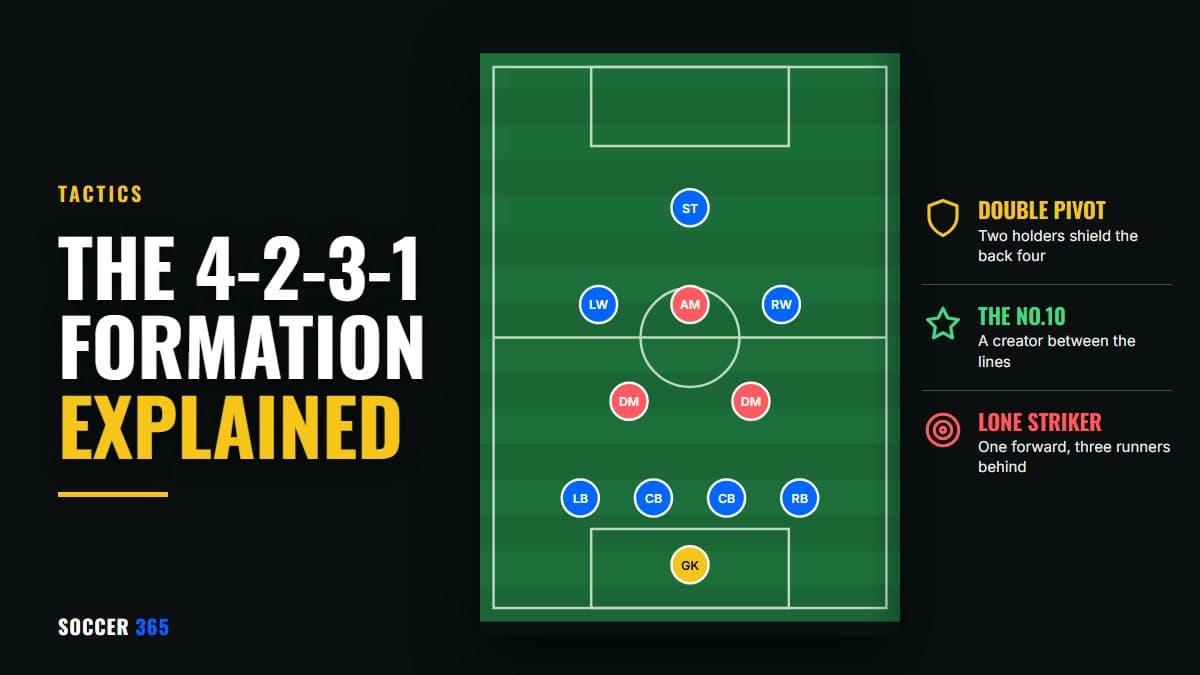
The 4-2-3-1 is a formation with four defenders, two holding midfielders, three attacking midfielders and one striker. Its defining feature is the double pivot: the two midfielders sitting in front of the back four, who give the side enough security to let the full-backs and the three players behind the striker attack. Without the ball it usually drops into a 4-4-1-1 or a 4-4-2.
It was the Premier League's most-used shape in 2023-24, when the league's own formation data counted 296 starts in a 4-2-3-1 out of 760 starting formations across the season, up from 261 the season before.
Where it came from
The shape grew out of the 4-4-2. According to the Premier League's tactics explainer, many teams in the late 1990s were playing a 4-4-2 with one striker dropping off, and the 4-2-3-1 arrived in the 2000s to shut off the central space between midfield and defence that the withdrawn forward was using. At first that job fell to a single holding midfielder, Claude Makélélé being the best-known example, before coaches added a second. The same piece credits Juanma Lillo, later Manchester City's assistant manager, with driving the move from 4-4-2 to 4-2-3-1 in Spanish football, and notes that the growth of pressing pushed more teams towards it.
By the 2010 World Cup it was the shape of the elite. FIFA's technical report on the tournament records that three of the four semi-finalists, the Netherlands, Germany and Spain, all used a 4-2-3-1, "but even so they all interpreted this system in their own way".
The shape, line by line
The back four. Two centre-backs and two full-backs. Because two midfielders are already screening them, the centre-backs rarely need to step into midfield; their job in possession is to move the ball into the pivot or play it forward directly. The full-backs are the side's main source of width once the wide attackers come inside, overlapping to cross or cut the ball back.
The double pivot. The heart of the system. FIFA's 2010 report puts it plainly: "The 4-2-3-1 formation is always based around two defensive central midfielders who provide stability for the defence and are also able to support their own team's attacks." In possession they sit underneath the ball, drift wide to help switch play, and one of them can push forward on the counter-attack. Without it they cover the space between the lines and support the press. FIFA's report said the leading pairs at that tournament "complemented each other perfectly in both attack and defence".
The attacking three. A No.10 in the middle and two wide attackers. The No.10 plays in the pocket between the opposing midfield and defence, and rotates with the striker to drag centre-backs out of position. The wide players are often "wrong-footed", a left-footer on the right or vice versa, so they can cut inside and shoot, which in turn opens the flank for the full-back behind them.
The striker. One centre-forward, supported by the No.10 as the main central threat. The striker also starts the press from the front.
What each player is asked to do
| Position | With the ball | Without the ball |
|---|---|---|
| Goalkeeper | Plays short to the centre-backs or pivot, or long to the striker | Organises the back four |
| Centre-backs | Pass into the pivot or play direct balls forward | Mark the striker, defend as a compact four |
| Full-backs | Overlap to provide width, cross or cut back | Tuck in, defend one-against-one with the opposing winger |
| Double pivot | Receive from the back, switch play, one joins the attack on the break | Screen the back four, cover between the lines, support the press |
| Wide attackers | Cut inside onto the stronger foot, run in behind | Drop back to form a midfield four |
| No.10 | Find space between the lines, rotate with the striker | Press alongside the striker or drop in front of the pivot |
| Striker | Main central threat, link play with the No.10 | Lead the press on the centre-backs |
How it changes without the ball
When possession is lost the wide attackers drop level with the double pivot and the side defends in two banks of four. The Premier League explainer describes it as a shape that "can therefore become an out-of-possession 4-4-2 or 4-4-1-1", depending on whether the No.10 steps up alongside the striker or sits just beneath.
The Premier League's review of 2023-24 formations treats the two as close relatives: a 4-4-1-1, it notes, "is very similar to a 4-2-3-1 and can probably be described as a slightly more defensive version of the same shape".
Strengths
Control of the middle. The two pivots plus the No.10 give a central three that can outnumber a two-man midfield, such as the one in a flat 4-4-2.
A safe base for attacking full-backs. Because two midfielders are always covering, both full-backs can join attacks without leaving the centre-backs exposed on their own.
A player between the lines. The No.10 operates in the space between the lines: in front of the opposing back four and behind its midfield.
Triangles everywhere. The staggered lines give the player on the ball lots of passing angles, which is why the Premier League explainer calls the shape "conducive to a possession-based game".
Easy to defend in. The 4-4-1-1 block without the ball is compact, and needs no substitution to switch into.
Weaknesses
An isolated striker. The single centre-forward is always outnumbered by the opposing centre-backs. If the No.10 and wide players cannot get close quickly, the striker is left fighting two defenders alone.
Being outnumbered in midfield. Against a side with four central midfielders, such as a 4-4-2 diamond, the 4-2-3-1's central three can be overrun.
A No.10 who does not track back. If the No.10 stays high when the team loses the ball, the double pivot faces three or more midfielders on its own.
Switches of play. If both full-backs have pushed on, a quick diagonal on the counter-attack can find a runner in the space behind them.
Slower support. With two players sitting deep, it can take longer for enough of the side to get forward and support the front four.
The teams that made it famous
The 2010 World Cup. FIFA's report names the double pivots of the tournament's leading sides: Bastian Schweinsteiger and Sami Khedira for Germany, Mark van Bommel and Nigel de Jong for the Netherlands, Xabi Alonso and Sergio Busquets for Spain. Spain played Xavi and Andrés Iniesta, both central midfielders by trade, in the wider attacking roles and let them swap positions, with David Villa moving into the centre-forward role once Pedro replaced Fernando Torres for the semi-final and final. Spain won all four knockout games 1-0, the final against the Netherlands settled by Iniesta's goal in the 116th minute of extra time.
José Mourinho's Real Madrid, 2011-12. Mourinho's side used a 4-2-3-1 in 36 of their 38 La Liga games that season, with Xabi Alonso and Sami Khedira as the pivot and Mesut Özil at No.10. It won the title with 100 points and 121 goals, Cristiano Ronaldo scoring 46 of them, and Özil's 17 assists were the most in the league.
Mauricio Pochettino's Tottenham. Harry Kane led the line with Dele Alli as a runner from No.10, Christian Eriksen operating at No.10 or out wide, and Eric Dier and Mousa Dembélé forming the pivot behind them, while Kyle Walker and Danny Rose overlapped from full-back.
Hansi Flick's Bayern Munich, 2019-20. Robert Lewandowski up front, Thomas Müller running beyond him from No.10, and Thiago controlling the tempo alongside either Leon Goretzka or Joshua Kimmich. That side beat Chelsea 7-1 on aggregate and Barcelona 8-2 on the way to winning the 2019-20 Champions League, 1-0 against Paris Saint-Germain in the final in Lisbon, and won all 11 of its games in the competition.
Gareth Southgate's England. At Euro 2020 England used Kalvin Phillips and Declan Rice as a double pivot whenever both were available, with Kane dropping deep and Mason Mount, Jack Grealish, Jadon Sancho and Phil Foden combining around him.
4-2-3-1 against the other common shapes
| Opponent | Where the 4-2-3-1 has the edge | Where it is exposed |
|---|---|---|
| 4-4-2 | Three central midfielders against two; No.10 free between the lines | Lone striker against two centre-backs |
| 4-4-2 diamond | Width from full-backs and wide attackers against a narrow midfield | Four central midfielders against three |
| 4-3-3 | No.10 can press the single holding midfielder | Three forwards can press the centre-backs and full-backs high |
| 3-5-2 | Wide attackers and full-backs can double up on a wing-back | Three centre-backs against one striker; three midfielders against the pivot and No.10 |
The last row is the mirror of the one in our 3-5-2 guide: a back three always has a spare man against a single striker, and the 4-2-3-1's answer is to attack the space behind the wing-backs.
When a coach picks it
A 4-2-3-1 suits a squad with two reliable holding midfielders, a creative player who wants to play centrally behind the striker, and wide players who like to come inside. It is also a flexible one: the defensive 4-4-1-1 needs no change of personnel.
It suits a squad less when the only good striker needs a partner, or when the opponent packs the centre with four midfielders. The wide attackers and the No.10 cover the most ground, pressing and then dropping into the midfield four, so they are the natural places to refresh the side; the limits on how many changes a coach can make are in football substitution rules.
Frequently Asked Questions
What is a 4-2-3-1 formation?
A shape with a back four, two defensive central midfielders (the double pivot), a line of three attacking midfielders and a single centre-forward. Without the ball it usually turns into a 4-4-1-1 or a 4-4-2.
What is the double pivot in a 4-2-3-1?
The two central midfielders who sit in front of the back four. They protect the space between defence and midfield, receive the ball from the centre-backs, switch play, and let the full-backs push on because there are already two players covering behind them.
Is the 4-2-3-1 attacking or defensive?
It can be both. With the full-backs overlapping and the No.10 close to the striker it attacks with five or six players; with the wide men dropping back it becomes a 4-4-1-1 block with two banks of four. The double pivot is what lets it switch between the two.
What is the main weakness of the 4-2-3-1?
The lone striker is always outnumbered by the opposing centre-backs and can become isolated. The shape can also be overrun in midfield by a side with four central midfielders, such as a 4-4-2 diamond, and is open to switches of play if both full-backs are caught upfield.
Which teams are famous for playing 4-2-3-1?
Spain's 2010 World Cup winners, the Netherlands and Germany at the same tournament, José Mourinho's Real Madrid in 2011-12, Mauricio Pochettino's Tottenham and Hansi Flick's Bayern Munich, who won the 2019-20 Champions League.
Is the 4-2-3-1 popular in the Premier League?
Yes. It was the most-used shape in 2023-24, when Premier League sides started in a 4-2-3-1 296 times out of 760 starting formations, up from 261 the season before, according to the Premier League's own data.
What is the difference between 4-2-3-1 and 4-3-3?
Both use a back four and three central players. The 4-2-3-1 has two holding midfielders and one No.10 behind the striker; the 4-3-3 usually has one holder and two midfielders ahead, with the wide forwards higher up alongside the striker.