The Goalkeeper 8-Second Rule Explained: Why Refs Award Corners Out of Nowhere
A simple guide to football's new goalkeeper 8-second rule: why holding the ball too long now gives away a corner, how the referee counts it, and why it replaced the old 6-second rule.
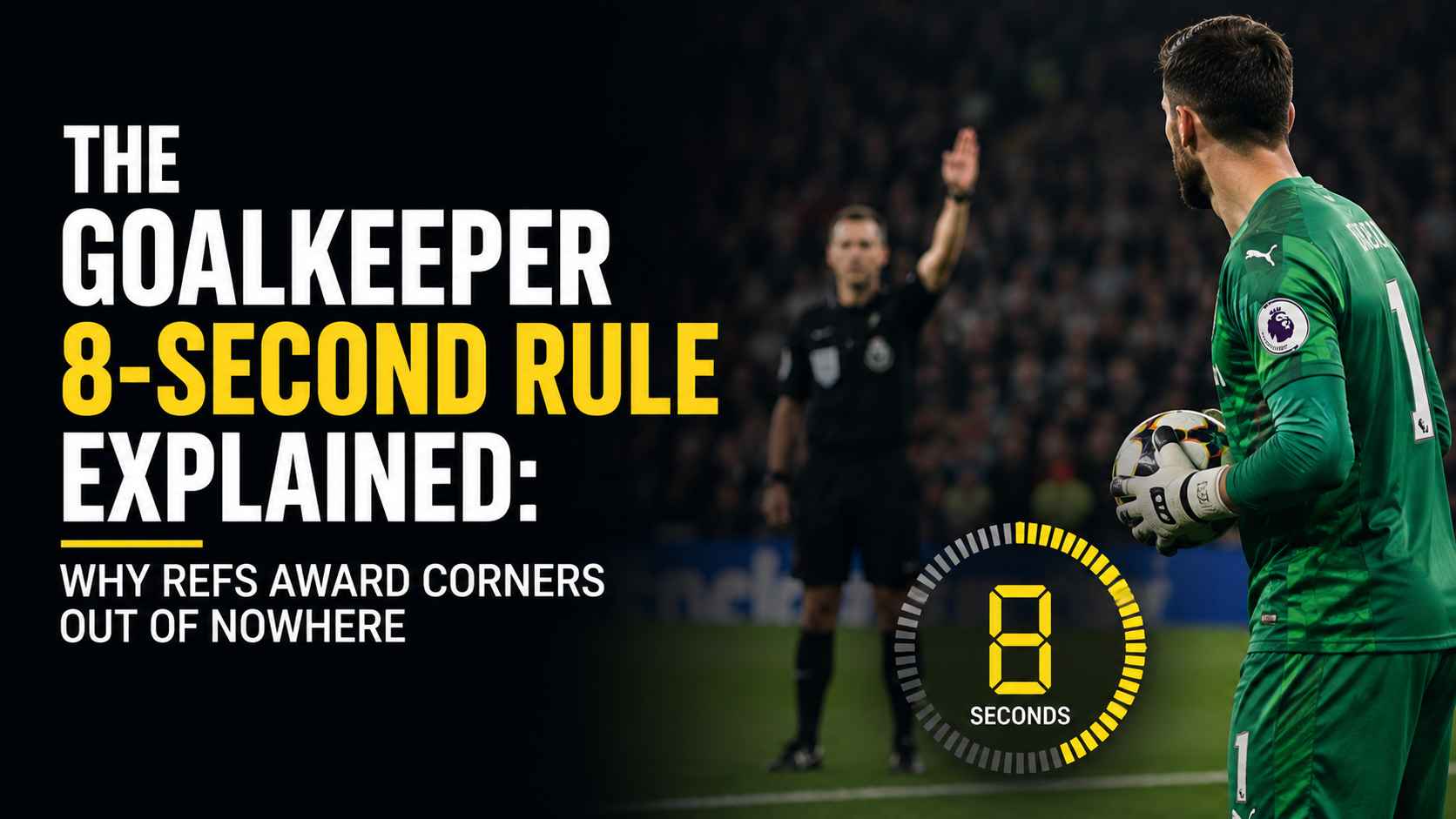
You're watching a match, the goalkeeper is just standing there holding the ball, and suddenly the referee points to the corner flag. No foul happened. No one touched the goalkeeper. If that's left you confused, you've just met football's newest law: the 8-second rule.
The basic idea
Once a goalkeeper has clear control of the ball in their hands, they now have 8 seconds to release it back into play. If they don't, the referee stops the clock on them and awards a corner kick to the other team.
It sounds small, but it's a deliberate fix for one of football's most common forms of time-wasting: a keeper hugging the ball in the box to run down the clock late in a match.
How the countdown actually works
This isn't a rule the referee just guesses at. It has a visible signal built in:
- The referee starts counting the moment the goalkeeper has clear control of the ball.
- For the first 3 seconds, nothing is shown, the referee counts silently.
- At the 5-seconds-remaining mark, the referee raises an arm and visibly counts down from five on their fingers.
- If the ball still hasn't been released by the time the count hits zero, the referee blows the whistle and awards a corner.
That raised arm is the tell. If you see a referee's arm go up near the penalty area with no goalkeeper under pressure, that's the countdown, not a random signal.
Why a corner, and not a free kick?
This is the part that trips people up most, because the previous version of this law punished the same offense completely differently.
Before 2025/26, going over the time limit (6 seconds back then) gave the opposition an indirect free kick from wherever the goalkeeper was standing. In practice, referees almost never enforced it. An indirect free kick that close to goal felt like too harsh a punishment to hand out for what is, on its face, a fairly minor offense, so referees mostly looked the other way.
IFAB's fix was to swap the punishment for something referees would actually be willing to give: a corner kick. It's simple to set up, doesn't require lining up a defensive wall, and still hands the attacking team a genuine chance without feeling disproportionate. Because it's an easier call to make, referees now actually use it.
What counts as "control" of the ball
The clock doesn't start the instant the goalkeeper touches the ball. It starts once they clearly control it, which includes:
- Holding the ball in one or both hands or arms.
- Holding it against any surface, like the ground or a post.
- Balancing it in an open, outstretched hand.
- Bouncing it on the ground or throwing it up and catching it again.
Notice that bouncing or throwing the ball up doesn't reset the clock. Goalkeepers used to be able to bounce the ball to buy extra time under the old rule; that loophole is closed now.
Old rule vs. new rule
| Old rule (before 2025/26) | New rule (2025/26 onward) | |
|---|---|---|
| Time limit | 6 seconds | 8 seconds |
| Punishment | Indirect free kick | Corner kick |
| How often enforced | Rarely | Far more often |
Does it actually get used?
Surprisingly rarely, and that's the point. In early trials across hundreds of matches, only a handful of corners were ever awarded under the new rule. Referees involved said that's exactly the sign it's working: goalkeepers see the threat of conceding a corner as a real deterrent, so they simply release the ball in time rather than risk it.
So don't expect to see this every week. But when a match is tight and a goalkeeper is tempted to sit on the ball to kill the clock, keep an eye on that raised arm.
Frequently Asked Questions
What is the goalkeeper 8-second rule?
It's a football law introduced for the 2025/26 season stating that if a goalkeeper controls the ball with their hands for more than 8 seconds without releasing it, the referee awards a corner kick to the opposing team.
What did the rule replace?
It replaced the old 6-second rule, under which holding the ball too long gave the opponents an indirect free kick instead of a corner.
How does the referee count the 8 seconds?
The referee counts silently for the first three seconds, then raises an arm and visibly counts down from five on their fingers. If the goalkeeper hasn't released the ball by zero, a corner is given.
Is a goalkeeper punished the first time they go over 8 seconds?
The corner itself is the punishment on the pitch, but IFAB also built in a card system: a first offense gets a warning, a second gets another warning, and a third earns a yellow card.
Is this rule being used at the World Cup 2026?
Yes. It's a global IFAB law change, not a domestic competition rule, so it applies at the World Cup 2026 and any other competition following the Laws of the Game.