The 'Only the Captain' Rule, Explained
Only one player per team may approach the referee, and it is normally the captain. What the rule allows, what gets you booked, and the goalkeeper exception.
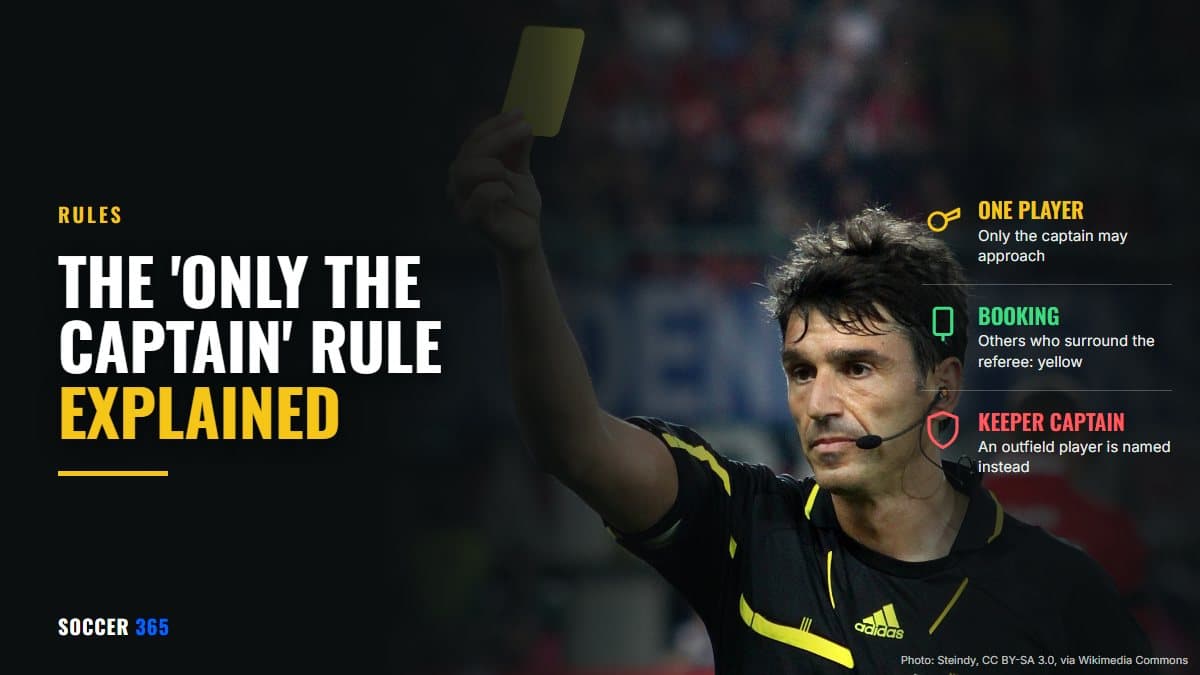
Only one player from each team is allowed to approach the referee about a big decision, and it is normally the captain. Everyone else has to stay away. Players who come anyway can be booked for it, and the approach itself has to be respectful or it becomes dissent.
The Laws of the Game put it plainly: one player, usually the captain, "and when doing so, they must always interact in a respectful manner."
What the rule is actually trying to fix
Anyone who has watched football for more than a season knows the picture. A penalty is given, or waved away, and six players arrive at once. Arms go up. Nobody is really asking a question. The referee retreats, the noise builds, and the whole thing looks less like a sport and more like an argument in a car park.
That image does real damage, and not mainly at the top level. It gets copied. A fourteen-year-old who watches ten players surround a Premier League referee on Saturday will try the same thing on Sunday morning, at a match where the official is a volunteer and there is no fourth official to hide behind.
The rule is an attempt to make one player responsible instead of eleven.
What is allowed and what is not
| Situation | Allowed? |
|---|---|
| Captain approaches after a major decision, respectfully | Yes |
| Normal talking to the referee during play | Yes |
| Three players jogging over to contest a call | No |
| Captain approaching but shouting or gesturing | No, that is dissent |
| Surrounding the referee | No |
Two separate things can get a player booked here, and it is worth keeping them apart.
The first is approaching when you are not the permitted player. That is an offence on its own. You do not have to say anything rude. Being there is enough.
The second is dissent, which is a caution whether you are the captain or not. The armband buys access, not immunity. A captain who arrives shouting is booked exactly like anyone else would be, and quite reasonably so, because the point of the rule was never to give one player a licence to argue on behalf of ten.
The goalkeeper exception
There is one obvious problem with a rule built around the captain, and the Laws deal with it directly: goalkeepers.
A goalkeeper captain cannot sprint eighty metres to discuss a decision at the other end, and nobody wants a match stopped while they do. So when the goalkeeper wears the armband, the team has to nominate an outfield player to approach the referee instead.
The timing matters. That nomination has to be made no later than the coin toss before kick-off, not improvised in the moment when something controversial happens. And it is one player, not two. A team does not get the goalkeeper and a stand-in.
Why "respectfully" is doing a lot of work
The wording gives referees latitude, and that is deliberate.
There is no list of banned words, no decibel limit, no defined distance for a normal approach. A referee judges whether the interaction was respectful, the same way they judge whether a challenge was careless or reckless. Two officials will draw that line slightly differently, and players will complain about it, and that is the ordinary condition of nearly every judgement call in football.
What the rule does provide is a much clearer starting position. Before it, an official arguing with five players had to decide who to book out of a crowd, which is an unenviable choice and one that invites accusations of picking on someone. Now the first question is simpler: were you supposed to be here at all?
The four-metre zone in youth football
Competitions below the elite level can go further. The Laws allow a marked zone of about four metres around the referee that only the captain may enter, with a hand signal to make the boundary obvious and progressive sanctions for players who cross it.
This is optional and it is aimed at grassroots and youth football, where the problem is worst and the officials are least protected. If you referee or watch junior football and see a signal you do not recognise, this is probably it.
What it changes in practice
Do not expect complaining to disappear. Players will still react, still throw their arms out, still make their feelings clear from a distance. None of that is banned, and none of it was ever the real problem.
What changes is the crowd. The referee deals with one player rather than a ring of them, the conversation happens at a normal volume, and the restart comes quicker. On television it looks like a small thing. On a public pitch on a Sunday, with one official and no cameras, it is not small at all.
If you want the wider picture of what gets a player booked and what the card actually costs them, the yellow and red cards guide covers the full list of cautionable offences, dissent among them.
Frequently Asked Questions
What is the 'only the captain' rule?
Only one player from each team, normally the captain, is allowed to approach the referee about a major decision, and they must do so respectfully. Other players who approach or surround the referee can be cautioned.
Can a player be booked just for approaching the referee?
Yes. Players who approach or surround the referee when they are not the permitted player may be shown a yellow card, and dissent by word or action is a caution in its own right.
What happens if the goalkeeper is the captain?
The team must tell the referee, no later than the coin toss before kick-off, which outfield player will approach instead. Only that nominated player may do so, not both of them.
Does the rule stop players talking to the referee at all?
No. Normal interaction during play continues as before. The rule targets the specific situation where a decision is disputed and players converge on the referee.
Is the captain guaranteed an explanation?
No. The captain is allowed to approach and ask respectfully. The referee may explain a significant decision, but the rule gives the captain access, not the right to an answer.
Is there a version of this rule for youth football?
Yes. Competitions may mark a four-metre zone around the referee that only the captain may enter, with progressive sanctions for players who cross it.