Yellow and Red Cards: The Rules of Cautions Explained
Every offence that earns a card, how suspensions work, whether a card can be rescinded on appeal, and why VAR can overturn a red but not a second yellow.
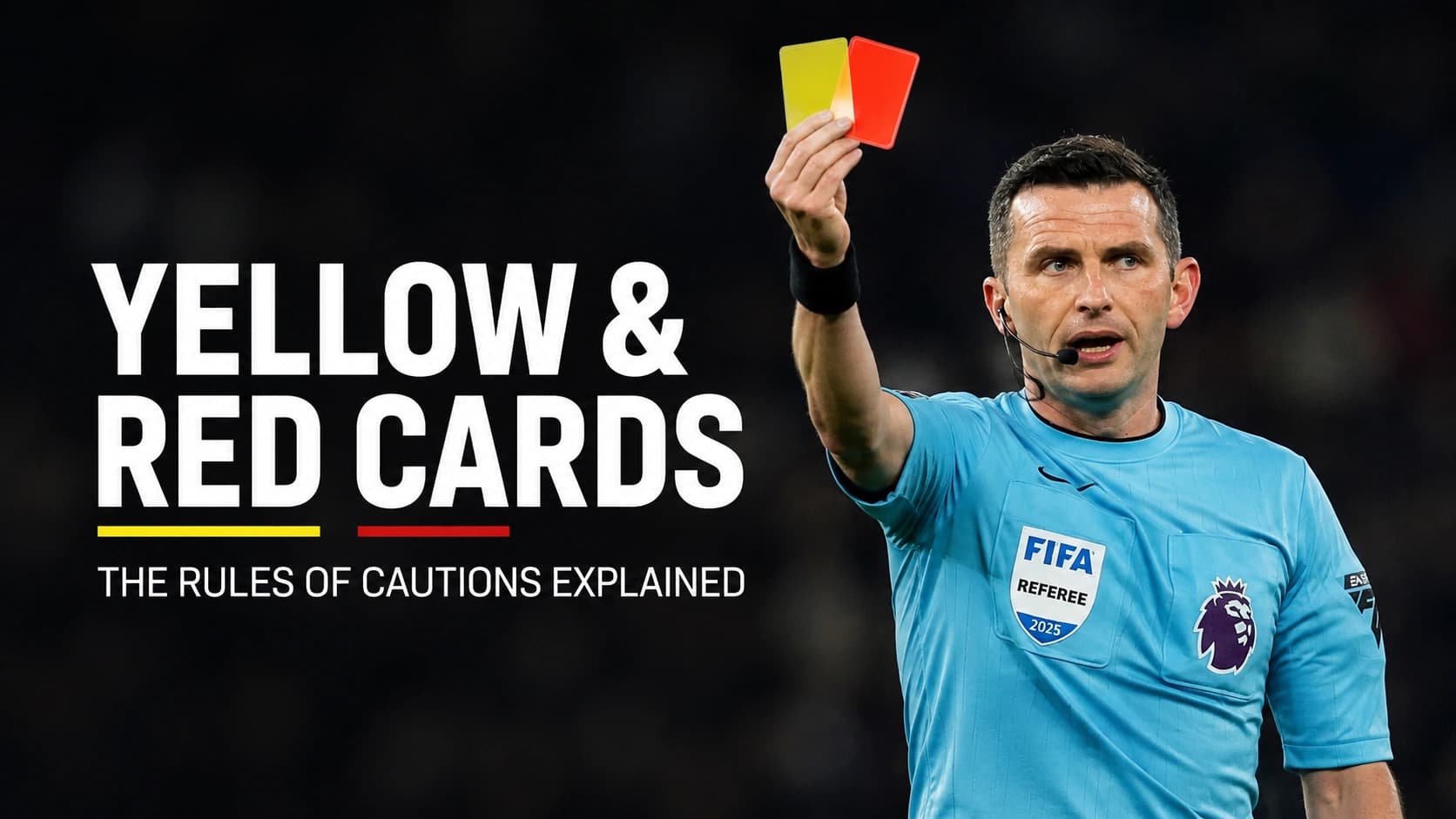
Yellow and red cards are how referees keep control of a match. Think of them as a two-step warning system: a yellow card is a caution that stays on the record, while a red card ends a player's afternoon on the spot.
That's the version everyone knows. The detail underneath it — which offences map to which card, what happens afterwards, and what can be challenged — is where most of the arguments actually happen.
What earns a yellow card
The Laws of the Game set out a defined list of cautionable offences. A referee doesn't get to invent categories; he decides whether what he saw fits one.
- Unsporting behaviour — the broadest category, covering reckless fouls, simulation, handling to stop an attack, and celebrating in ways the Laws prohibit.
- Dissent by word or action.
- Persistent offences. No single foul deserves a card, but the accumulation does. This is the one players complain about most, because there's no fixed number at which it triggers.
- Delaying the restart of play — time-wasting.
- Failing to respect the required distance at a corner, free kick or throw-in.
- Entering or re-entering the field without permission, or deliberately leaving it without permission.
A caution is a formal warning with consequences attached. Commit a second cautionable offence in the same match and the referee has no discretion left.
What earns a straight red card
Some offences skip the warning entirely:
- Serious foul play — a challenge using excessive force or endangering an opponent's safety.
- Violent conduct — striking or attempting to strike someone, whether or not the ball is anywhere nearby, and whether or not the target is an opponent.
- Spitting at anyone.
- Denying an obvious goalscoring opportunity by handball.
- Denying an obvious goalscoring opportunity by a foul — with an important exception, below.
- Offensive, insulting or abusive language or gestures.
- Receiving a second caution in the same match.
The penalty-area exception people find confusing
You'll regularly see a defender concede a penalty for a clear foul on a striker clean through on goal — and receive only a yellow card. This looks like leniency. It isn't; it's a deliberate rule change.
The old position was known as triple punishment: the attacking team got a penalty, the defender was sent off, and he was then suspended for the next match. Three penalties for one offence, and it frequently ruined the game as a contest.
The Laws were amended so that where a defender denies a goalscoring opportunity inside the penalty area while making a genuine attempt to play the ball, and a penalty is awarded, the offence becomes a caution rather than a dismissal.
The exceptions to the exception matter:
- Holding, pushing, pulling, or no attempt to play the ball — still a red card.
- Handball to deny a goal or an obvious opportunity — still a red card.
- Outside the penalty area — still a red card, because there's no penalty compensating the attacking team.
So the question a referee is answering isn't "was it a foul?" but "was he genuinely trying to play the ball, in the box, with a penalty given?"
Two yellows equal one red
If a player picks up a second caution in the same game, the referee shows the yellow and then the red. The player leaves the field.
The distinction from a straight red is what happens next. A dismissal for two cautions normally carries the minimum suspension, usually a single match. A straight red — particularly for violent conduct — can carry considerably more, and the length is set by the competition's disciplinary process rather than by the referee.
One asymmetry catches teams out badly: VAR cannot intervene on a second yellow card. The video assistant can review a straight red, and can recommend one the referee missed, but a second caution sits outside its remit. A player sent off for two soft yellows has no in-match remedy, while a player shown a straight red for the same incident would have had one. Our guide to how VAR works sets out exactly what the system can and cannot touch.
What happens after the whistle
A sending-off has immediate consequences and delayed ones.
Immediately: the team plays on a player short. A red card cannot be replaced by a substitute — that's the point of it.
Afterwards: the player serves a suspension. Two yellows typically means one match. A straight red means at least one, and often more depending on the offence, with violent conduct carrying the heaviest bans. Competitions maintain their own disciplinary panels, which review footage and confirm, extend, or occasionally reduce the punishment.
Suspensions are also competition-specific. A ban picked up in a domestic cup does not automatically apply in the league, and vice versa. Bans in international competition follow their own rules again. This is why a player can be suspended on Saturday and available on Wednesday.
Accumulation: the quiet suspension
Beyond sendings-off, most competitions suspend players who collect a set number of cautions across separate matches — commonly five in a league season, though the number and the deadline vary and are set by the competition, not by the Laws of the Game.
Two features are worth knowing:
- The count resets at a defined point. Tournaments usually wipe single yellows at a set stage, often after the group phase or the quarter-finals, so a player doesn't miss a final for a caution picked up months earlier.
- The threshold usually tightens as the season progresses, with fewer cards required to trigger a ban early on than late.
Managers plan around this. A player on four yellows in a title race gets rested for a fixture the team expects to win comfortably.
Can a card be rescinded?
This is the question that produces the most confusion, because the answer is different for the two colours.
Red cards: yes, they can be appealed. A club can challenge a dismissal, and a disciplinary panel can overturn it, wiping the suspension. Appeals succeed most reliably where there's a factual error — mistaken identity, or an incident the panel can see was plainly not what the referee believed. Appeals against judgement — "it wasn't really excessive force" — succeed far less often, because panels are reluctant to substitute their opinion for the referee's on a subjective call. Many competitions also penalise frivolous appeals by extending the original ban, which is a real deterrent.
Yellow cards: generally, no. Individual cautions are usually not appealable at all. The reasoning is practical: thousands of yellows are shown every season, and a right of appeal against each one would collapse under its own weight.
There are narrow exceptions:
- Mistaken identity. If the referee booked the wrong player, that can be corrected, because it's a factual error rather than a judgement.
- Simulation. Some national associations operate a separate process for deceiving a match official, which can cut both ways — reviewing a card given for a dive, or punishing a player who won one.
- Where the caution triggers a suspension, some competitions allow a challenge to the suspension itself rather than the card.
Appeals against cards in international competition follow the governing body's own disciplinary code, which is why federations sometimes petition FIFA directly over a booking that would rule a player out of a knockout match — as in the case of France's appeal over Olise's yellow card and the wider Balogun ruling on card appeals.
Cards for people who aren't players
Since 2019, referees have been able to show cards to coaches and team officials in the technical area. Before that a referee could only order someone from the touchline, with no formal record.
The offences mirror the player list adapted to the dugout: dissent, delaying a restart, entering the field, and abusive conduct. A dismissed official leaves the technical area entirely.
Where the offender cannot be identified — a coordinated protest from a bench, for instance — the senior coach present receives the card.
The short version
- Yellow is a caution from a defined list, and two in a match means dismissal.
- Red is for a defined set of serious offences, and the team plays a man down.
- A penalty-area foul with a genuine attempt to play the ball is a caution, not a dismissal.
- VAR reaches straight reds, never second yellows.
- Reds can be appealed; yellows almost never can, outside mistaken identity.
The colour tells you what happened in the moment. The competition's disciplinary rules decide what it actually costs.
Frequently Asked Questions
Can a yellow card be rescinded?
In most competitions, no. Yellow cards are generally not appealable, because allowing appeals against every caution would be unworkable. The main exception is mistaken identity, where the wrong player was booked, and some national associations additionally allow a card for simulation to be reviewed.
Can a red card be rescinded?
Yes. Clubs can appeal a sending-off, and a disciplinary panel can overturn it. Appeals succeed most often on mistaken identity or clear factual error; appeals against a referee's judgement rarely succeed, and a frivolous appeal can see the ban extended.
How many yellow cards before a suspension?
Two yellows in the same match means a sending-off and normally a one-match ban. Accumulating yellows across several matches also triggers a suspension, but the threshold is set by each competition rather than by the Laws of the Game.
Does a yellow card carry over to the next match?
A single caution does not cause a ban on its own, but it stays on your record and counts towards the accumulation total. Competitions usually wipe accumulated yellows at a defined stage, such as after the group phase or the quarter-finals.
Why is a foul in the penalty area sometimes only a yellow card?
Because of the change to the so-called triple punishment. If a defender denies a goalscoring opportunity while making a genuine attempt to play the ball inside the penalty area, and a penalty is awarded, the offence is a caution rather than a sending-off. Holding, pulling or handball still bring a red.
Can VAR overturn a card?
VAR can review a straight red card, and can recommend a red the referee missed. It cannot intervene on a second yellow card, which is why a player dismissed for two cautions has no route to review during the match.
Can a manager be shown a card?
Yes. Since 2019 referees have been able to caution and dismiss coaches and other team officials in the technical area, rather than simply ordering them from the touchline.
Can a goalkeeper be sent off?
Yes, under the same rules as anyone else, and goalkeepers have an extra exposure: handling the ball outside the penalty area to stop an attack. If a keeper is dismissed and all substitutes have been used, an outfield player must take the gloves.