What Is VAR and How Does It Work?
A plain-English guide to the Video Assistant Referee system: what it checks, what it doesn't, and why fans still argue about it.
Football (or soccer) used to rely entirely on the human eye. If a referee missed a fast-moving foul or an offside position, the mistake stood forever.
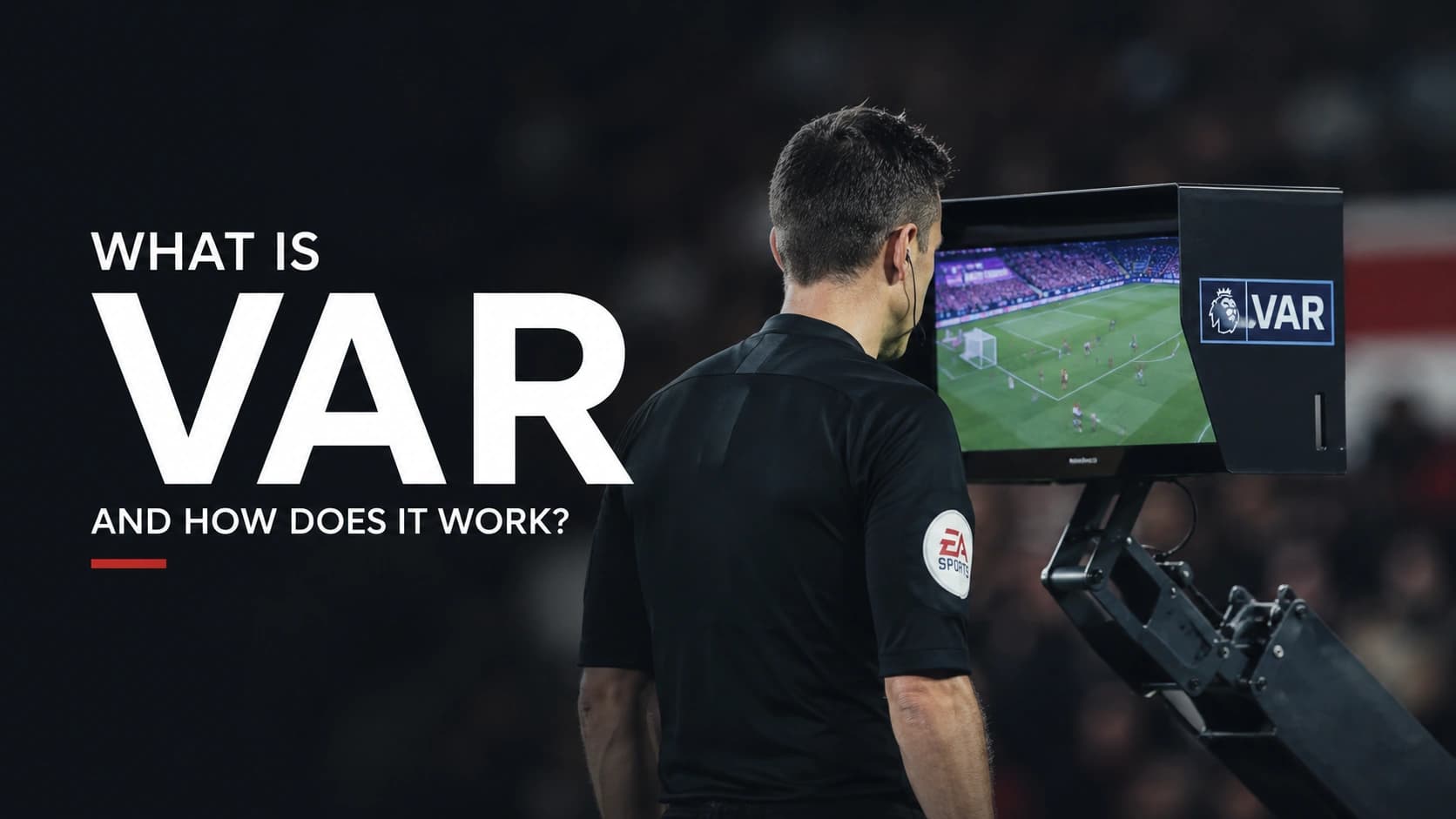
To fix this, football introduced VAR, which stands for Video Assistant Referee. It is not a machine or a robot; it is a team of real human replay officials sitting in a centralized video hub surrounded by TV screens. Their job is to act as a safety net for the main referee out on the pitch.
However, VAR doesn't control the entire game. The system operates under a strict "minimum interference, maximum benefit" philosophy, meaning it only steps in to correct major blunders.
The four situations VAR can check
To keep the game flowing naturally, the video team cannot stop the match for minor mistakes like a misplaced throw-in or an incorrect corner kick. Under the VAR protocol in the Laws of the Game, they are allowed to intervene in only four game-changing scenarios:
- Goals – When a team scores, VAR checks the entire build-up play. They ensure the ball didn't go out of bounds, no player committed a foul, and no one was in an illegal offside position before hitting the net.
- Penalty decisions – A penalty is a free shot at goal given after a foul occurs inside the penalty box. Because they almost always lead to goals, VAR closely analyzes whether a penalty was wrongly awarded or mistakenly ignored.
- Direct red cards – If a player commits a dangerous, violent, or injury-threatening foul, they receive a red card and are ejected from the match. VAR checks these to ensure players are fairly penalized, though it ignores minor yellow-card warnings.
- Mistaken identity – In the chaos of a crowded field, a referee might accidentally show a card to the wrong player. VAR steps in simply to say, "Number 7 committed the foul, not number 9."
The technology behind the screen
The VAR room functions like a high-tech television broadcast center. The replay officials have access to every single camera angle available in the stadium.
Hawk-Eye and Hawk-Eye Innovations
The system uses specialized software to sync up every camera feed down to the exact millisecond. When checking if a player is offside, tech operators manually pick the exact frame the ball leaves a passing player's foot.
Semi-Automated Offside Technology (SAOT)
In modern high-level tournaments, computer vision takes over offside tracking. Multiple dedicated tracking cameras around the stadium trace up to 29 distinct points on each player's body 50 times per second. Combined with a tracking chip inside the match ball, artificial intelligence generates a 3D virtual line automatically, drastically reducing human error and long waiting times.
Step-by-step: how a review happens
The review process follows a strict chain of communication to ensure the main referee on the field always retains ultimate control.
- The incident occurs – A major moment happens on the pitch, such as a defender tackling an attacker inside the penalty box. The referee either blows the whistle for a penalty or signals for play to continue.
- The silent check – Within seconds, while players keep moving, the VAR team in the control room instantly watches the incident from multiple angles. If they agree with the referee's initial call, the game continues without interruption.
- The intervention – If the video team spots a "clear and obvious error" (e.g. the defender completely missed the ball and kicked the attacker's leg instead), they speak directly into the referee's earpiece, advising them to pause the match.
- On-field review (OFR) – For subjective decisions like fouls, the referee runs over to a dedicated, pitch-side TV monitor. Watching the same slow-motion replays as the VAR team, the referee re-evaluates the moment firsthand.
- The final decision – The main referee steps back onto the field, makes a visible box signal with their hands to indicate a video review, and announces the final, unappealable decision.
Real-world examples: fact vs. judgment
To truly understand why football fans still debate VAR, you have to look at the difference between factual calls and subjective judgments.
Example 1: The factual call (offside)
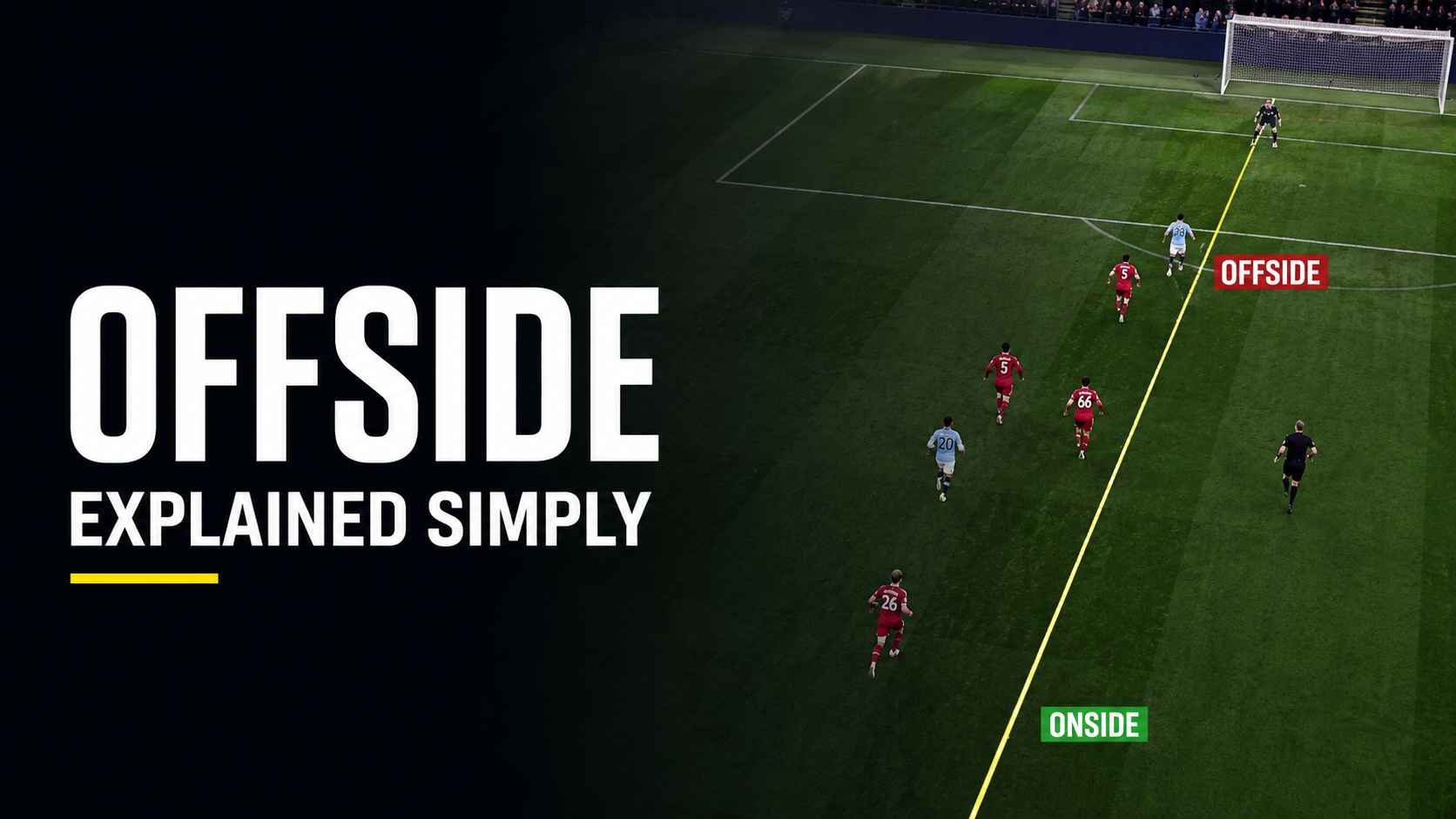
Imagine a striker scores a beautiful goal. However, the camera technology proves that the tip of the striker's shoulder was 2 inches ahead of the last defender when the ball was kicked.
This is a factual, black-or-white rule. You are either offside or you are not. VAR draws the lines, proves the player was ahead, and the goal is immediately canceled. There is no human opinion involved.
Example 2: The subjective judgment (the handball rule)
A midfielder shoots the ball, and it strikes a defending player's hand inside the box. The rule states that a handball is an offense if a player makes their body "unnaturally bigger." If the defender was jumping or spinning, their arms naturally flail out for balance, so what exactly counts as "unnaturally bigger" isn't always clear.
VAR will show the referee the replay from three angles. But because the rule requires human interpretation of intent and natural movement, fans and experts will still fiercely debate the referee's final decision long after the match ends. VAR provides clear pictures, but it cannot read a player's mind. Our guide to the handball rule sets out where the arm legally ends and what "unnaturally bigger" actually means.
What VAR cannot touch
The four categories are a hard boundary, and most complaints about VAR are really complaints about things outside it.
VAR cannot review:
- Second yellow cards. A player dismissed for two cautions has no route to review, even though a straight red for the identical incident would have been checked. Our guide to yellow and red cards covers why that asymmetry exists.
- First yellow cards of any kind.
- Corners, throw-ins and goal kicks — including a corner wrongly awarded that leads directly to a goal. The goal itself gets checked; the corner that produced it does not.
- Free kicks outside the penalty area, however clearly wrong.
- Any foul that does not produce a goal, a penalty or a red card.
So a referee can award a corner that never was, and a goal scored from it stands, provided nothing in the goal itself was illegal. That is the system working as designed, not a malfunction.
How far back a review goes
A common question when a goal is disallowed for something that happened much earlier: how far back is VAR allowed to look?
The answer is the attacking possession phase — back to the moment the scoring team gained control of the ball in that passage of play. If a foul or an offside occurred within that phase, the goal falls. If the same offence happened before the team won possession, it is out of scope and the goal stands.
This is why a goal can be ruled out for a handball three passes earlier, but not for a foul in midfield two minutes before. The phase, not the clock, sets the limit.
Goal-line technology is not VAR
These get conflated constantly, and they are entirely separate systems.
Goal-line technology answers exactly one question: did the whole ball cross the whole line? It is fully automatic, uses dedicated cameras or a magnetic field, and sends a signal to the referee's watch within about a second. No human is involved and there is no review.
VAR is a team of officials watching replays and advising on four categories of decision. It is slower because it involves judgement.
If play carries on instantly after a scramble on the line, that is goal-line technology having already answered. If everyone stands around waiting, that is VAR.
Teams cannot ask for a review
Football has no challenge system in its standard Laws. A manager cannot throw a flag, and a captain cannot demand a look. Only the video officials can initiate a check.
Players who make the television-screen signal at the referee to demand a review are committing a cautionable offence, and are booked for it.
Some competitions have trialled a limited coach-challenge mechanism in lower-stakes settings, but at the top level the principle remains that reviews are triggered by the officials, not requested by the participants.
Why people still find it frustrating
Understanding the design explains most of the frustration, and doesn't dissolve it.
- The threshold is "clear and obvious." VAR is not there to find the best decision, only to remove indefensible ones. A call that was probably wrong but arguable is left alone — which looks, from the stands, like the system refusing to do its job.
- Delays break the game's rhythm, and a celebration cancelled two minutes later is a worse experience than a goal that never counted.
- Subjective calls stay subjective. More camera angles do not make a handball rule easier to apply.
- The scope surprises people. Most incidents fans want reviewed were never eligible.
Some competitions now have the referee announce the outcome of a review over the stadium public address, explaining what was checked and what was decided. It does not make the decision more popular, but it removes the several minutes in which nobody in the ground knows what is happening.
VAR was introduced to eliminate the clearest injustices, and it does that. It was never built to settle arguments, and it hasn't.
Frequently Asked Questions
What can VAR review?
Goals, penalty decisions, direct red card incidents and cases of mistaken identity.
Can VAR overturn any referee decision?
No. VAR is limited to those four categories and is intended only to correct clear and obvious errors, not subjective judgement calls.
Why does the referee sometimes go to the sideline monitor?
For subjective calls, like whether a foul deserves a penalty or a red card, VAR can only recommend a review. The referee then watches the replay personally and makes the final call, since the decision relies on judgement rather than a clear factual error.
Can a team ask for a VAR review?
No. Football has no challenge system in its standard laws. Only the video officials can initiate a check, and a player or manager who demands one by making the screen signal can be cautioned for it.
Is goal-line technology the same as VAR?
No, they are separate systems. Goal-line technology is automatic, decides only whether the ball fully crossed the line, and signals the referee's watch within a second. VAR involves human officials reviewing footage and covers entirely different decisions.
What can VAR not review?
Almost everything outside its four categories: second yellow cards, corners, throw-ins, free kicks outside the box, and any foul that does not lead directly to a goal, a penalty or a red card. A wrong decision in those areas stands.
How far back in the move can VAR check?
Back to the start of the attacking phase that produced the goal, not indefinitely. If the attacking team gained control of the ball through a foul or an offside earlier in that phase, the goal can be disallowed.
Why do VAR checks take so long?
Offside checks require lining up multiple camera angles with the exact frame the ball was played, and penalty or red card reviews often involve slow-motion replays from several angles. Most checks are silent and finish in under a minute, but a full on-field review can take several minutes.