How League Tables and Points Work
What every column in a league table means, how ties are separated differently across competitions, and why games in hand make the table lie.
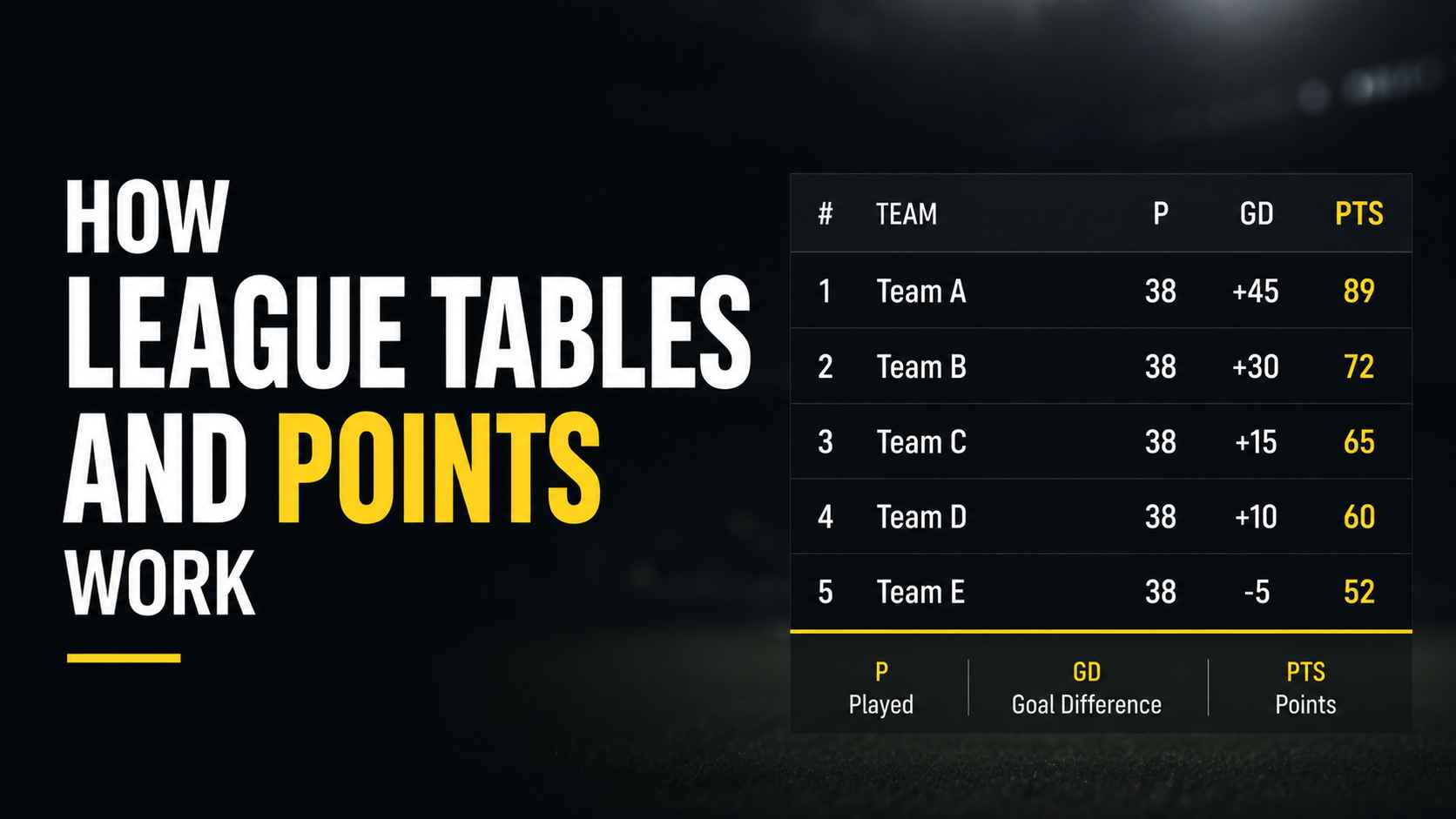
A football league table ranks teams by points, and points come from results: 3 for a win, 1 for a draw, 0 for a defeat. Whoever has the most points when every team has played every other team is champion. Everything after that is tie-breakers and detail.
Every table looks like a wall of numbers at first. Underneath, it is doing that one simple thing — and then a handful of rules decide what happens when two teams end up level.
How a season is structured
A league season is every team playing every other team, usually twice: once at home, once away. Each match awards points on the scale above, and the table re-sorts after every round.
Why three points and not two
Leagues originally awarded two points for a win. That made a draw worth half a win, which is a lot — a team protecting a point was giving up relatively little.
Moving to three points widened the gap. A win became worth three times a draw rather than twice, so chasing a winner late in a tight game became mathematically more attractive than settling. England adopted it in the early 1980s, and it spread worldwide over the following decade.
Reading a table, column by column
Different sites and broadcasters abbreviate the same columns differently, which is where most of the confusion comes from. Every common version:
| Column | Also written as | Means |
|---|---|---|
| Pos | #, Rank | League position |
| P | MP, GP, Pld, M | Matches played so far |
| W | Wins | |
| D | T (tie, in US usage) | Draws |
| L | Losses | |
| GF | F, GS, Goals | Goals scored (for) |
| GA | A, GC | Goals conceded (against) |
| GD | +/-, Diff | Goal difference: GF minus GA |
| Pts | PTS, P | Points: 3 per win, 1 per draw, which sets the order |
| Form | Last 5 | Recent results, oldest first. Context only; it has no bearing on position |
So a row reading MP 10, W 7, D 2, L 1, GF 20, GA 8, GD +12, Pts 23 means ten games played, seven won, two drawn, one lost, twenty goals scored, eight conceded, a goal difference of plus twelve, and 23 points (7 × 3 + 2 × 1).
Watch for P: some tables use it for played and others for points. If the column sits at the far right, it is points.
A quick way to read a table properly: check the Played column first. Position means nothing until you know everyone has played the same number of games.
Games in hand
If a team has played fewer matches than those around it, it has games in hand, and the table is understating where it might end up.
A side sitting four points behind with two games in hand is potentially two points ahead. It hasn't earned those points yet — games in hand have to actually be won, and often aren't — but the visible gap is misleading.
Some tables offer points per game for this reason, dividing points by matches played to give a comparable rate. It's a better guide mid-season than raw position, particularly in leagues where fixture backlogs are common.
What happens when teams are level on points
This is where competitions genuinely differ, and where most confusion comes from. There is no single worldwide rule.
The goal-difference-first model, used in England and many other leagues:
- Goal difference
- Goals scored
- Head-to-head record between the tied teams
- A playoff, if a title, relegation place or European spot is at stake
The head-to-head-first model, used in Spain and elsewhere:
- Results between the tied teams
- Goal difference in those matches between them
- Overall goal difference
- Goals scored
The difference is not academic. Two teams finishing level can end up ranked in opposite order depending on which country they're playing in. A team with a much better goal difference can still finish below a rival that beat it twice.
So the honest answer to "who finishes above who?" is: read that competition's rules. They're published, and they vary.
Points deductions
Occasionally a team's points total won't match its results. That's a deduction, applied by the competition as a sanction.
Common causes:
- Insolvency or administration — most leagues impose an automatic penalty
- Financial or spending-rule breaches
- Fielding an ineligible player, sometimes alongside the result being altered
- Serious disciplinary or governance breaches
Deductions are usually shown in the table with a marker next to the points total. They can be significant enough to define a season on their own, and they're frequently under appeal while the table is being published — meaning the standings can change months after the matches were played.
Promotion and relegation
Most football pyramids stack divisions on top of each other.
- The top teams in a division get promoted.
- The bottom teams get relegated.
Not all promotion is automatic. Many leagues promote the top one or two directly and then run a playoff among the next several, so a team finishing sixth can go up ahead of one finishing third. It's designed for drama rather than fairness, and it succeeds at that.
This structure is what keeps mid-table matches meaningful in March, and it's the main structural difference between European football and closed-league sports elsewhere.
Qualification places
Above relegation, the table also allocates entry to continental competitions — typically the top few places, with a lower spot or two feeding a secondary tournament.
Two wrinkles worth knowing:
- Cup winners usually qualify too, and if they've already qualified through the league, the place normally passes down to the next team in the table. This is why a club finishing outside the qualifying places can still get in.
- The number of places a country receives varies, based on how its clubs have performed in Europe over previous seasons.
What those places lead into changed recently: see how the Champions League format works.
Groups and knockouts
Not every competition is a season-long league.
- Knockout cups — lose once and you're out.
- Group stage then knockouts — teams play a mini-league, and the top finishers advance.
Group tables use the same points system, but frequently different tiebreakers. Many tournaments separate level teams by head-to-head results before goal difference, precisely because a group is only a few matches long and one 5-0 result would otherwise distort everything.
Some competitions have moved away from small groups towards a single large table where each team plays a different set of opponents. The points work identically; the ranking simply covers far more teams, with the top finishers advancing directly and those below entering a playoff round.
The short version
- Three points a win, one a draw.
- Check Played before position — games in hand change everything.
- Goal difference is the usual first tiebreaker, but not everywhere. Spain uses head-to-head.
- Points can be deducted for off-field breaches.
- Group stages often use different tiebreakers than leagues.
Points, tiebreakers and promotion rules are set by each competition rather than by the Laws of the Game; the Premier League Handbook is the published source for England. The Laws themselves are maintained by the IFAB.
Frequently Asked Questions
What do MP, W, D, L, GF, GA, GD and Pts mean in a football table?
MP is matches played, W wins, D draws, L losses, GF goals for (scored), GA goals against (conceded), GD goal difference (GF minus GA) and Pts points, which decide the order.
How many points do you get for a win?
Three for a win, one each for a draw, none for a loss. This is standard across almost every league in the world.
What is goal difference?
Goals scored minus goals conceded. It is the most common first tiebreaker when teams finish level on points, and a team with a better goal difference is ranked higher.
Is goal difference always the first tiebreaker?
No, and this catches people out. England uses goal difference first, but Spain separates level teams by their head-to-head record against each other before goal difference is considered. Always check the competition's own rules.
What does 'games in hand' mean?
That a team has played fewer matches than the teams around it. A side three points behind with a game in hand is level on points if it wins that match, so the table understates its position.
Why do some teams have negative points or fewer points than their results suggest?
Points deductions. Competitions dock points for breaches such as entering administration, fielding an ineligible player, or breaking financial rules. The deduction is applied to the table directly.
Why not two points for a win, like it used to be?
Because a draw was worth half a win, which made defending a point too attractive. Three points widened the gap between winning and drawing to encourage teams to chase the result.
What does the form column show?
The results of a team's most recent matches, usually the last five, shown oldest to newest. It carries no weight in the standings and is context only.
Why do group stages use different tiebreakers from leagues?
Because groups are short. With only a handful of matches, goal difference can be distorted by one heavy win, so many tournaments look at head-to-head results between the tied teams first.