
PSR and Football's Financial Rules, Explained
How profit and sustainability rules work, what is deducted from the calculation, why breaches cost points, and the squad cost ratio replacing them.
Every season a club signs nobody in January and the explanation is PSR. Every season a club with an extremely wealthy owner claims it cannot afford a player. Both are usually true, and neither is about how much money exists in the bank.
The problem these rules were written for
Football clubs have a long history of spending money they do not have. An owner arrives, funds enormous losses chasing promotion or a European place, and either succeeds or leaves the club insolvent when the money stops.
The failures were not rare and not small. Clubs with long histories have gone into administration, been docked points, and in some cases dropped several divisions. The damage lands on supporters, staff and local creditors, none of whom made the decision.
Financial regulation in football exists to make that harder. Whether it also entrenches the clubs that were already rich is a separate argument, and a fair one.
How PSR actually works
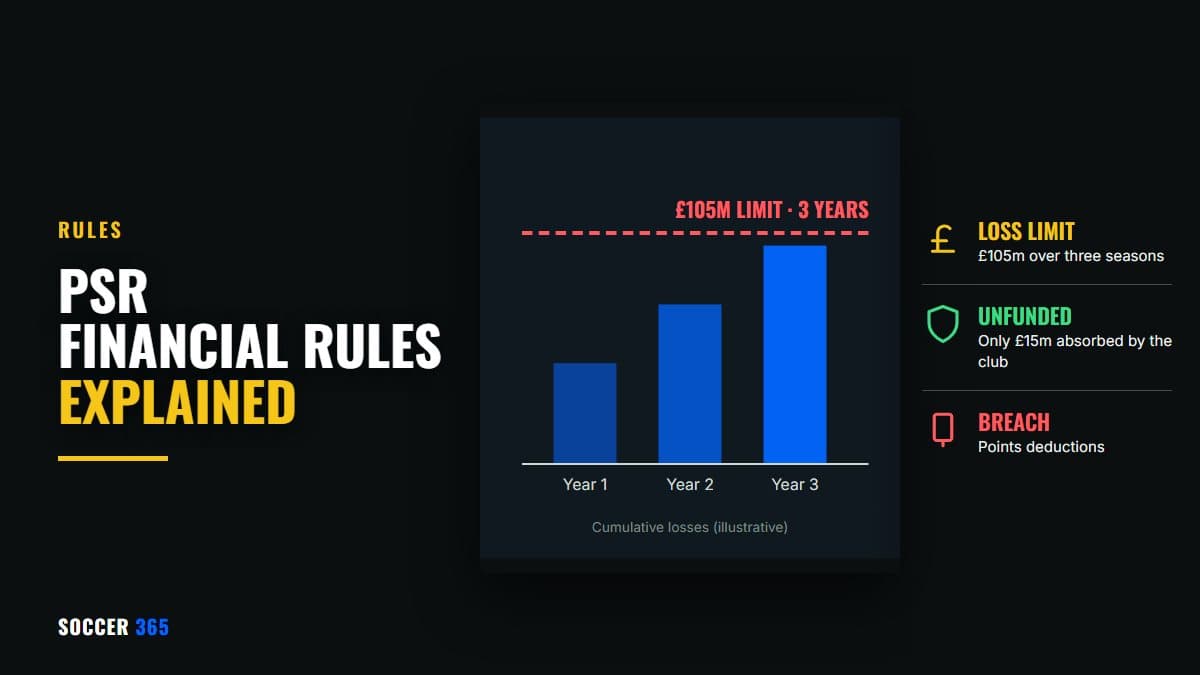
The Premier League's Profitability and Sustainability Rules assess a club's losses over a rolling three-year period. Every season, the window moves forward and the oldest season drops out.
The permitted total is £105m across those three years, and the composition matters as much as the number:
- £15m may be losses the club simply absorbs.
- The remaining £90m must be covered by secure funding, meaning owners putting real money in as equity rather than lending it.
That distinction is the part most coverage skips, and it is the reason ownership wealth does not convert straight into transfer budget. An owner can absorb losses up to the cap by buying shares. Beyond it, willingness to pay is irrelevant. The rule caps the loss, not the funding.
Rolling three-year windows also produce a specific behaviour. A club that had one very bad year knows exactly when that year drops out of the calculation, and plans its spending around that date.
What does not count
Not all spending counts against the limit. Clubs may generally deduct:
- Youth development and academy costs
- Women's football
- Community and charitable programmes
- Infrastructure, such as stadium and training ground investment
The logic is that these build something lasting rather than funding a squad, so the rules should not discourage them.
This creates one of the sharpest incentives in football. Academy spending is deductible, and academy sales count as full profit, because a homegrown player has no purchase price to write off. A club under pressure therefore has an obvious lever, and it is the one that hurts it most in ten years' time. Our guide to why clubs sell their best academy players works through the arithmetic.
Why the accounts matter more than the cash
Clubs are judged on accounting figures, not on their bank balance, and the two diverge constantly.
A transfer fee is not recorded in the year it is paid. It is amortised, spread across the length of the contract, so an £80m signing on a four-year deal appears as £20m a year. Meanwhile a sale produces profit equal to the fee minus whatever is left of the player's original cost on the books.
The consequences are counterintuitive and worth holding onto:
- A club can sell a player for a large fee and record a loss on the deal.
- A club can be flush with cash and still be unable to register a signing.
- Selling a player who cost nothing helps far more than selling one who cost a fortune.
What a breach costs
The standard sanction is a points deduction, applied directly to the league table, sometimes with part of it suspended.
This is why a table occasionally shows a club on fewer points than its results imply, and why standings can change months after the matches were played. Deductions can be appealed and have been reduced on appeal. Our guide to how league tables and points work covers how they appear in the table.
Points deductions are a deliberate choice of punishment. A fine on a club funded by a wealthy owner is a cost of doing business. Relegation is a sporting outcome nobody can buy their way out of, and it makes the sanction real.
UEFA has its own rules
A club in European competition satisfies two frameworks, not one.
UEFA's system works differently. Rather than capping losses, it caps squad costs as a share of revenue: wages, transfer amortisation and agent fees together must stay under a set percentage of what the club earns. That ceiling was phased in, 90 per cent in 2023/24 and 80 per cent in 2024/25, before settling at 70 per cent from 2025/26. The detail sits in UEFA's Club Licensing and Financial Sustainability Regulations.
The two systems can pull in different directions. A club can be comfortable domestically and constrained in Europe, or the reverse, which is part of why financial explanations from clubs sound evasive. They are often describing a different rule from the one you are thinking of.
What replaced PSR
The loss-based model is no longer the Premier League's main financial rule. A new framework came into full force at the start of the 2026/27 season, after running alongside the old one in shadow form during 2025/26. It has two parts:
- Squad Cost Ratio (SCR), capping on-pitch spending at 85 per cent of football revenue plus net profit or loss from player sales. On-pitch spending means wages, transfer amortisation and agent fees, the same basket UEFA uses.
- Sustainability and Systemic Resilience (SSR), covering solvency and whether a club can meet its obligations.
Clubs also get an allowance of 30 per cent on top, so the point at which sporting sanctions come into play sits at 115 per cent rather than 85. Financial penalties for breaching it, called levies, only become payable from 2027/28.
Two things follow. The ceiling is higher than UEFA's 70 per cent, so a club can satisfy the Premier League and still be constrained in Europe. And because the limit is tied to revenue, it entrenches the existing order more directly than a loss cap did: the clubs earning most are permitted to spend most.
The Premier League's own explanation of the system is here, and the binding text is in the Handbook.
Do these rules work
Depends what you think they are for.
As a solvency measure, reasonably well. Fewer clubs at the top level are running the kind of losses that used to end in administration, and there is a hard limit rather than an owner's appetite.
As a competitive measure, badly, and arguably backwards. A rule tying spending to revenue locks in the existing order, because the clubs with the largest revenue are permitted the largest spend. A club trying to break into that group finds the rule binds hardest exactly when it tries to invest. Owners of ambitious mid-table clubs have said this publicly and they have a point.
As a system, it produced one clear behavioural outcome nobody set out to create: the fastest way for a club to fix its accounting position is to sell the young players it spent a decade developing.
The short version
- £105m of losses over a rolling three years, of which only £15m can be unfunded.
- The rest needs secure funding, real equity from owners.
- Youth, women's football, community and infrastructure spending is deducted.
- Judged on accounts, not cash, so amortisation drives everything.
- Breaches cost points, not just money.
- UEFA runs a separate framework, based on squad cost as a share of revenue.
- PSR has been replaced. From 2026/27 the Premier League runs a squad cost ratio capped at 85 per cent of revenue, with a 30 per cent allowance on top, alongside solvency rules.
Updated 19 September 2026. This guide originally said the timing of PSR's replacement was disputed and told readers to check the Premier League handbook. That is no longer accurate: the squad cost ratio came into full force at the start of the 2026/27 season, and the relevant sections have been rewritten rather than amended in place. The UEFA ceiling, previously left unspecified, is now stated as 70 per cent with a source.
Frequently Asked Questions
What does PSR stand for?
Profitability and Sustainability Rules, the Premier League's framework limiting how much a club could lose over a rolling three-year period. It was the main financial rule until the 2026/27 season, when a squad cost ratio replaced it.
How much could a club lose under PSR?
£105m across three seasons, of which only £15m could be losses the club absorbed itself. The rest had to be covered by owners putting real money in as equity, known as secure funding.
Why can't a rich owner just pay for everything?
Because the rules cap losses regardless of who is willing to fund them. An owner can cover losses up to the limit through equity, but no further, so wealth does not translate directly into spending power.
What is deducted from the PSR calculation?
Spending on youth development, women's football, community projects and infrastructure is generally excluded. A club can invest in those without it counting against its permitted losses.
What happens if a club breaches PSR?
The usual sanction is a points deduction applied to the league table, sometimes suspended in part. Clubs can appeal, and deductions have been reduced on appeal before.
Why do clubs sell academy players to satisfy PSR?
Because an academy player has no purchase cost to write off, so the whole sale fee counts as accounting profit. It is the most efficient way to improve the figure quickly.
What is the squad cost ratio?
The rule that replaced PSR from the 2026/27 season. It caps on-pitch spending at 85 per cent of football revenue plus net profit from player sales, with a 30 per cent allowance on top before sporting sanctions apply. UEFA runs its own version at 70 per cent.
Are UEFA's rules the same as the Premier League's?
No. Both now cap squad costs as a share of revenue, but UEFA's ceiling is 70 per cent against the Premier League's 85, so a club can satisfy one and breach the other.