Offside, Explained Simply
The offside rule in plain English: the picture to remember, why an offside position is not an offence on its own, and the situations where offside cannot be given at all.
Offside is the rule that confuses new football fans the most. The core idea is simple, and this guide starts there — then covers the details that decide most of the arguments you'll see on a Saturday.
The one picture to remember
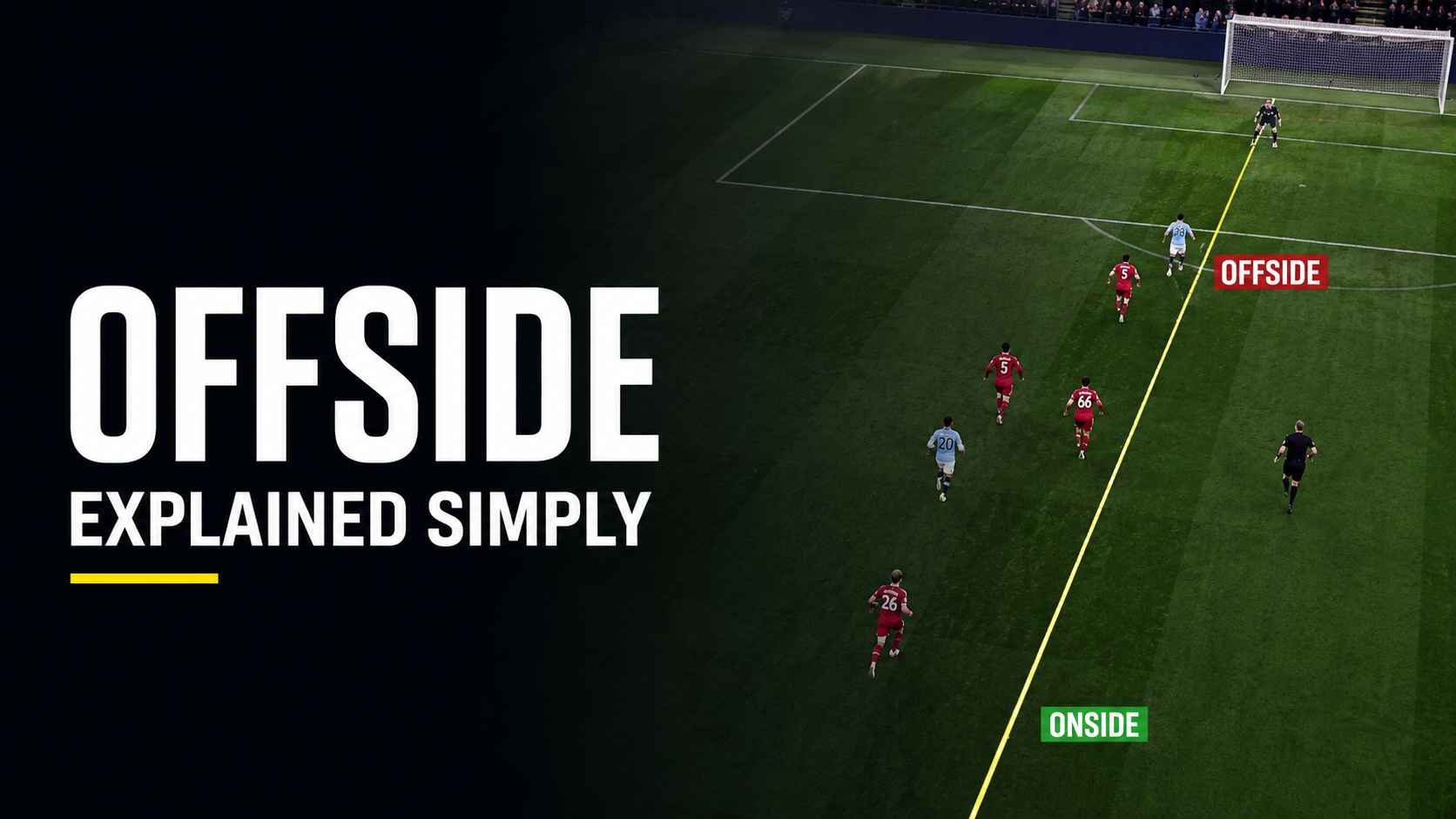
Imagine an invisible line drawn across the pitch, level with the second-last opponent — usually the last outfield defender, with the goalkeeper being the other one.
An attacking player is in an offside position if, at the moment a teammate plays the ball, they are nearer to the opponents' goal line than both that line and the ball itself. That wording comes from Law 11.
That's the picture. Almost everything else is refinement.
Why "second-last opponent" and not "last defender"
You'll hear "the last defender" everywhere, including in the original version of this guide. It's a useful shorthand, and it's slightly wrong.
The Law counts opponents, not positions, and it counts two of them. Normally the goalkeeper is one and the deepest defender is the other, so "the last defender" gets you the right answer. But if a goalkeeper charges upfield for a late corner, there's no goalkeeper at the back at all — and the rule still works, because it simply uses whichever two opponents are furthest back.
Why the rule exists
Without it, an attacker could stand next to the goalkeeper for ninety minutes waiting for a long ball. Scoring would be trivial and the game would be dull.
Offside forces attackers to time their runs instead of camping near the goal, and it lets defences push up the pitch, which is what creates the compressed, contested middle third that modern football is played in.
The part everyone gets wrong: position isn't an offence
This is the single biggest misunderstanding, and it explains most of the shouting.
Being in an offside position is not against the rules. A player can stand in an offside position for the entire match and never commit an offence.
It becomes an offence only if, at the moment the ball is played by a teammate, that player then becomes involved in active play in one of three ways:
- Interfering with play — touching or playing the ball, or challenging for it.
- Interfering with an opponent — blocking a defender's path or line of vision, or making a movement that clearly affects an opponent's ability to play the ball. This is why a striker standing offside and ducking out of the way of a shot can still be penalised: he obstructed the goalkeeper's sight of it.
- Gaining an advantage from being in that position — playing a ball that has rebounded off a post, the crossbar, a match official, or an opponent's deliberate save.
So the assistant referee is answering two separate questions, in order. Was he in an offside position? And then: did he do anything about it?
Which parts of the body count
Only the head, body and feet are measured.
Arms and hands are excluded — for attackers and defenders both. The logic is straightforward: you can't legally score with your arm, so an arm hanging beyond the defensive line isn't an advantage worth penalising.
This is why frozen VAR images show lines drawn to a shoulder rather than a fingertip, and why a forward whose arm is clearly beyond the line can still be onside.
When offside cannot be given at all
Three restarts are exempt. There is no offside offence directly from:
- a throw-in
- a corner kick
- a goal kick
A player can receive the ball in the most offside-looking position imaginable from any of these, and play simply continues. Note the word directly — once the ball has been played on by a teammate, normal offside applies again.
And offside can only happen in the opponents' half. A player level with the halfway line counts as being in their own half, and is onside.
The moment that matters
Offside is judged at the instant the ball is played by the teammate, not when it arrives.
Two consequences follow, and they're the source of endless confusion:
- A player who was onside when the pass was played can sprint past the entire defence and be perfectly legal, however offside he looks when he collects it.
- A player who was offside when the pass was played stays offside even if he runs back into an onside position before touching it.
Speed is irrelevant. Who reaches the ball first is irrelevant. It's one frozen moment.
When a defender plays the ball
Here's the situation that produces the most disputed decisions.
If a defender deliberately plays the ball — a controlled clearance, an attempted pass, a genuine act of playing it — an attacker in an offside position is generally no longer penalised. The defensive action has, in effect, reset the situation.
But if the ball merely deflects off a defender who had no control over it, or rebounds off a deliberate save, the offside offence stands. A save is treated differently from a clearance precisely so that a striker can't loiter offside waiting for a parried shot.
The dividing line is whether the defender had control of what he was doing — whether it was a deliberate act or something that happened to him. That judgement is why two very similar-looking incidents can be given differently.
Where VAR comes in
Because the decision depends on a single frozen frame, it's genuinely beyond what a human eye can resolve at speed. An assistant referee is watching the passer and the line at the same time, from an angle, at full sprint.
This is why replay technology now checks tight offside calls, and why semi-automated systems using body-tracking have been introduced to speed the process up and remove some of the manual line-drawing. Our guide to how VAR works covers what the system can and cannot review, and why offside checks take longer than other decisions.
It's also worth knowing that offside is a factual matter, not a judgement call. That's why VAR can overturn it outright without the referee going to the monitor, unlike a penalty decision.
What happens when offside is given
Play stops. The defending team gets an indirect free kick — meaning a goal can't be scored directly from it — taken from where the offside player was standing when the ball was played to them.
That last detail catches people out. The free kick isn't taken from where the player received the ball, and it isn't taken from where the pass came from. It's the offside position itself, which can be deep in the defending team's half.
The short version
- Offside position: nearer the goal line than both the ball and the second-last opponent, in the opponents' half.
- Level is onside. Arms don't count.
- Position alone is not an offence — the player must interfere with play, interfere with an opponent, or gain an advantage.
- Judged at the moment the ball is played, not when it arrives.
- No offside from a throw-in, corner or goal kick.
- Result: indirect free kick from where the offside player was.
Frequently Asked Questions
What is offside in the simplest terms?
An attacking player is offside if they are nearer to the opponents' goal line than both the ball and the second-last opponent at the moment a teammate plays the ball, and they then get involved in the play.
Is it offside if a player is level with the last defender?
No. Level is onside. The attacker has to be ahead of the second-last opponent, not alongside them.
Is being in an offside position a foul?
No, and this is the most misunderstood part of the rule. Standing in an offside position is not an offence at all. It only becomes one if the player then interferes with play, interferes with an opponent, or gains an advantage from being there.
Why is it the second-last opponent and not the last defender?
Because the goalkeeper is usually, but not always, one of the two. The Law counts opponents rather than naming positions, so if a goalkeeper comes upfield the rule still works, using the two defenders furthest back instead.
Can you be offside from a throw-in or a corner?
No. There is no offside offence directly from a throw-in, a corner kick or a goal kick.
Can you be offside in your own half?
No. A player must be in the opponents' half, and standing on the halfway line counts as being in your own half.
Do the arms count for offside?
No. Only the head, body and feet are measured, because those are the parts a player can legally score with. Arms and hands are excluded for attackers and defenders alike.
What happens when a player is offside?
Play stops and the defending team gets an indirect free kick from the place where the offside player was when the ball was played to them, not from where they eventually received it.