
How the 48-Team World Cup 2026 Format Works
48 teams, 12 groups, and a round of 32 for the first time. How qualification works, how third-placed teams are ranked, and what it does to the group stage.
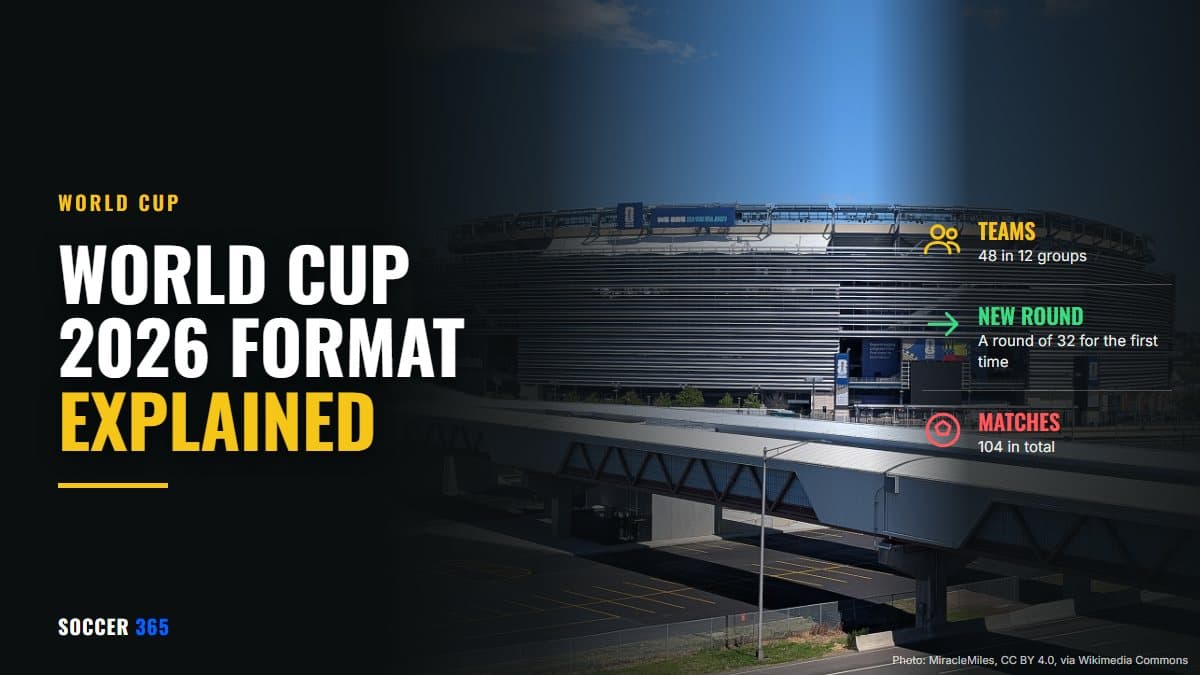
The World Cup got bigger. Forty-eight teams instead of 32, 104 matches instead of 64, and a knockout round that has never existed before. Here is how the whole thing fits together.
The shape of it
Forty-eight teams, twelve groups of four. Each team plays the other three in its group once, so three group matches each, exactly as before.
What changed is everything after that. Under the old format, 32 teams meant eight groups and a straightforward rule: top two go through, 16 teams reach the round of 16, done. Twelve groups of four does not divide neatly into a knockout bracket, and that awkwardness is what shapes the rest of the tournament.
How you qualify from a group
The top two in every group advance. Twelve groups, two each, 24 teams.
A knockout bracket needs a power of two. Twenty-four is not one, so FIFA fills the gap by taking the eight best third-placed teams from across all 12 groups. That brings the total to 32.
This is not new in principle. The 24-team World Cups of the 1980s used the same device, as have European Championships since expanding to 24. What is new is the scale: eight of the twelve third-placed teams get through, so finishing third is far more often survivable than not.
Ranking the third-placed teams
Twelve teams finish third. Eight continue. They are compared against each other in a separate mini-table, ranked on:
- Points
- Goal difference
- Goals scored
- Disciplinary record, meaning cards accumulated
- Drawing of lots, only if everything above is identical
Two things follow from this that matter while you are watching.
Goal difference stops being local. A third-placed team is not only competing with the two sides above it, it is competing with eleven other third-placed teams it will never play. A heavy defeat in the final group match can knock you out even if the result changes nothing in your own group.
Discipline can decide a tournament place. Cards sit above a coin toss in the order, so a team on the same points, goal difference and goals scored as a rival goes through on having been better behaved. Our guide to yellow and red cards covers how those are recorded.
Note that this ordering is not the same as the one used within a group, where head-to-head results between the tied teams normally come into play. Third-placed teams have not played each other, so there is no head-to-head to use. Our guide to how league tables and points work covers why tiebreakers differ between formats.
The round of 32
With 32 teams in the knockouts rather than 16, an extra round appears at the front. The bracket runs:
- Round of 32 — 32 teams, 16 matches
- Round of 16
- Quarter-finals
- Semi-finals
- Final, with a third-place playoff alongside it
Every knockout match is single-leg. Level after 90 minutes means extra time, and level after that means a shootout. Our guide to extra time and penalty shootouts covers exactly how those work.
A team that wins the tournament plays eight matches: three in the group and five knockouts. Under the old format it was seven. One extra match at the end of a long season, in a tournament spread across a continent.
104 matches
The total goes from 64 to 104. Seventy-two in the group stage, 32 in the knockouts.
That is a 62 per cent increase in matches for a 50 per cent increase in teams, and the extra comes from the additional knockout round. For broadcasters and host cities this is the point of the exercise. For players it is another line on a calendar that most of them already describe as unsustainable.
Three host countries
2026 is the first World Cup with three hosts: the United States, Canada and Mexico.
The practical consequence is travel. Venues are separated by distances that would cross several countries in Europe, across multiple time zones and radically different climates. Group allocation to regional clusters mitigates some of this, but a team progressing deep into the knockouts covers serious ground.
Does the format work
The honest answer is that the group stage lost most of its jeopardy.
Only 16 of 48 teams go home after the groups. Two thirds of the tournament survives. Under the old format, half the field was eliminated at that point, and a bad first match genuinely threatened your tournament.
Now a team can lose its opening game, draw the second, and still qualify comfortably in third. That removes a lot of what made World Cup group stages tense, and it front-loads the tournament with matches that cannot eliminate anybody.
What the expansion buys in return is real, and worth stating fairly. Sixteen more nations reach a World Cup, many of them from confederations that historically got one or two places for entire continents. For a country qualifying for the first time, the argument about group-stage jeopardy is not the point.
The trade is a less dramatic first ten days in exchange for a genuinely global field. Whether that is worth it depends on whether you are watching as a neutral or as someone whose country has never been.
The short version
- 48 teams, 12 groups of four, three matches each.
- Top two from every group advance, plus the eight best third-placed teams.
- That makes 32 teams in the knockouts and a brand new round of 32.
- Third-placed teams are ranked on points, goal difference, goals scored, then discipline.
- 104 matches total; the winner plays eight.
- Only 16 teams are eliminated in the group stage.
Tournament structure and schedule are published by FIFA on the World Cup 26 site.
Frequently Asked Questions
How many teams are at the 2026 World Cup?
Forty-eight, up from 32. They are split into 12 groups of four, and each team plays three group matches.
How many teams qualify from each group?
The top two from all 12 groups go through automatically, which is 24 teams. The eight best third-placed teams across all the groups join them, making 32 in the knockout stage.
What is the round of 32?
A new opening knockout round created by the expansion. With 32 teams advancing rather than 16, an extra round sits ahead of the round of 16.
How are the best third-placed teams decided?
They are ranked against each other on points first, then goal difference, then goals scored, then disciplinary record, with lots drawn only if teams are still level.
How many matches are there in total?
One hundred and four, up from 64 at a 32-team tournament: 72 in the group stage and 32 in the knockouts.
How many teams are eliminated in the group stage?
Only 16 of the 48. Two thirds of the tournament survives the group phase, which is the main criticism of the format.
Does the winner play more matches than before?
Yes. A team that goes all the way plays eight matches rather than the seven required under the 32-team format.
Where is the 2026 World Cup held?
Across three countries: the United States, Canada and Mexico. It is the first World Cup with three hosts.