
The 4-4-2 Formation Explained: Roles, Strengths and Weaknesses
Two banks of four and a front two. How the 4-4-2 actually works, drawn out, why it ruled English football for decades, and where it still wins.
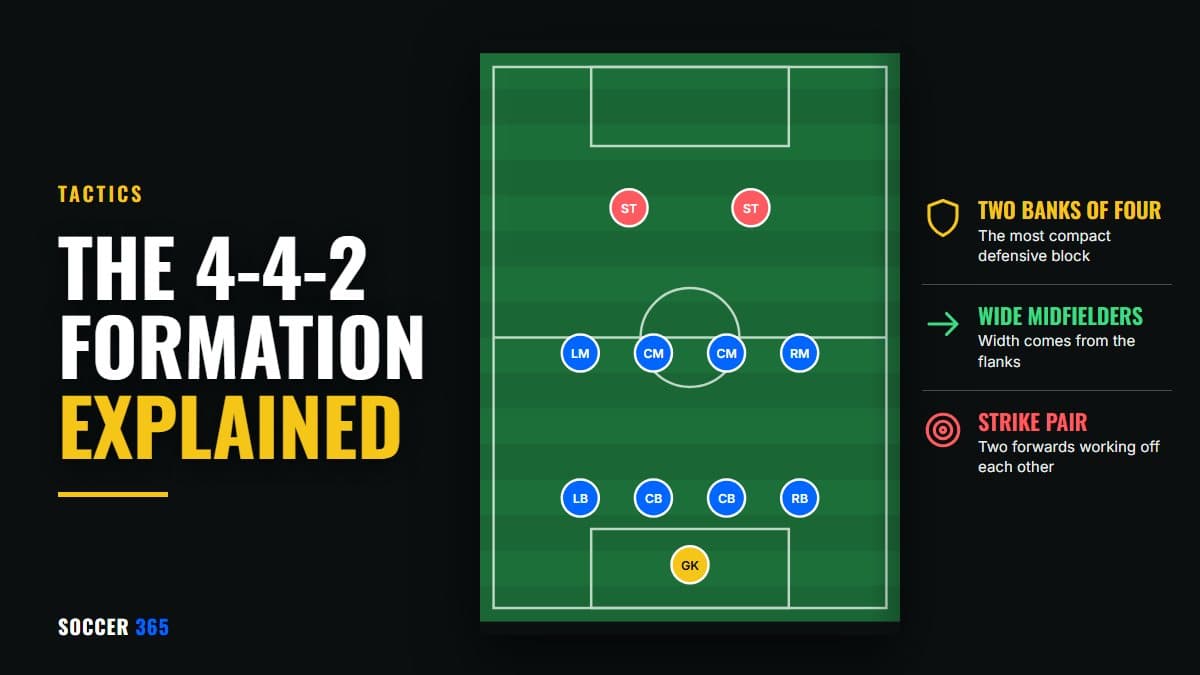
The 4-4-2 is a formation with four defenders, four midfielders and two strikers, set out in three flat lines. Its defining features are the pair of centre-forwards, who keep both opposing centre-backs busy all game, and the two banks of four behind them, which make it one of the most compact shapes in football when the team does not have the ball.
It has been squeezed in recent years by shapes with three central midfielders, but the sides that have won with it, from Milan to Leicester, show why it never quite goes away.
Where it came from
The 4-4-2 grew out of the 4-2-4. According to the Premier League's tactics explainer, produced with Coaches' Voice, Brazil won their first World Cup in 1958 playing a 4-2-4, while the Russian coach Viktor Maslov developed a variation in which the two wingers dropped back alongside the two central midfielders. That gave his side more bodies in midfield, and with an organised pressing game Maslov led Dynamo Kyiv to three consecutive league titles in the late 1960s.
The idea of wide players who attack and then defend as midfielders is still the heart of the shape today.
The shape, line by line
The back four. Two centre-backs and two full-backs. In possession, the explainer describes the centre-backs feeding passes forward, switching play and driving into the midfield channels when they are given space. The full-backs offer delayed support, overlapping when the wide midfielder in front of them comes inside.
The central midfield two. They connect defence to attack. With only two of them, both usually have to be box-to-box players: passing, running and tackling across the whole middle of the pitch.
The wide midfielders. They attack around the opposing back line and cross, or drift into the inside channels. Out of possession they drop level with the central pair to complete the midfield four, which is what turns the formation from an attacking shape into a defensive one.
The front two. Two centre-forwards who occupy the opposing centre-backs, hold the ball up and create space for each other and for the midfield runners. The classic partnership pairs a target man with a quicker runner, the combination set out in our guide to types of striker.
What each player is asked to do
| Position | With the ball | Without the ball |
|---|---|---|
| Goalkeeper | Plays short to the centre-backs or long to the strikers | Organises the back four |
| Centre-backs | Pass forward, switch play, carry into midfield when space opens | Mark attackers between the lines, clear crosses |
| Full-backs | Overlap when the wide midfielder comes inside | Step out to press in wide areas |
| Central midfielders | Link defence and attack, arrive in the box | Keep the midfield four compact, cover the centre |
| Wide midfielders | Cross, run beyond the back line, cut inside | Drop into the midfield four, track the opposing full-back |
| Strikers | Occupy both centre-backs, hold up the ball, run in behind | Press the opposing back line, block passes into midfield |
How it changes without the ball
Without the ball the 4-4-2 becomes two banks of four with the strikers in front. The Premier League explainer describes the two forwards pressing the back line while the midfield four stays compact, shifting across to cover the centre when the ball goes wide; the full-backs jump out to press in wide areas, and the centre-backs deal with anything that gets between the lines.
When one of the two strikers drops off to defend in front of the midfield, the shape becomes a 4-4-1-1. Leicester did exactly that in 2015-16: the Premier League's account of their title says Claudio Ranieri's side stuck with a 4-4-2 that "became a 4-4-1-1 out of possession" in 35 of their 38 matches.
Strengths
Two strikers on two centre-backs. Both opposing centre-backs always have someone to mark, so neither is free to step into midfield or cover for a team-mate.
Compactness. Two flat lines of four, close together, leave little room between or behind them. Arrigo Sacchi, according to Coaches' Voice, insisted his Milan side keep no more than 25 metres between their defensive and front lines.
Built for the counter-attack. With two forwards already high when the ball is won, a 4-4-2 can break quickly without waiting for runners. Leicester averaged 42.43 per cent possession in 2015-16, by the Premier League's account the lowest for any champions since data collection began in 2003-04.
Full-backs rarely outnumbered. Each full-back has a wide midfielder directly in front of him, so the flanks are rarely two-against-one.
Simple to learn. Every player has a clear partner beside him and a clear opponent in front of him.
Weaknesses
Outnumbered in the middle. The Premier League explainer is blunt: "Teams setting up in a 4-4-2 can face overloads in central midfield, particularly against opposition fielding a midfield three." Against a 4-3-3 or a 3-5-2, one opposing midfielder is always free.
Line-breaking passes. A flat midfield four can be passed through, and a ball that beats it lands in the space in front of the back four.
Blocked forward passes. With few players between the lines, the team's own forward passing options can be cut off by a well-organised opponent.
Less staggering. Compared with a 4-1-4-1, which has a holding midfielder sitting behind the midfield line, the flat 4-4-2 has less cover when its first line is broken.
The teams that made it famous
| Team | Seasons | What it won |
|---|---|---|
| Arrigo Sacchi's AC Milan | 1987-91 | Serie A in his first season; European Cup in 1989 and 1990 |
| Sir Alex Ferguson's Manchester United | 1998-99 | Premier League, FA Cup and Champions League |
| Arsène Wenger's Arsenal | 2003-04 | Premier League, unbeaten in 38 games |
| Diego Simeone's Atlético Madrid | 2013-14 | La Liga, with 90 points |
| Claudio Ranieri's Leicester City | 2015-16 | Premier League, with 81 points |
Sacchi's Milan. UEFA describes Sacchi's sides as operating "a 4-4-2 with zonal marking, a high defensive line and an efficient offside trap, also pressing opponents hard". The back four of Mauro Tassotti, Alessandro Costacurta, Franco Baresi and Paolo Maldini advanced as one to leave receivers offside, with Frank Rijkaard and Carlo Ancelotti in midfield. Milan won back-to-back European Cups in 1989 and 1990.
Ferguson's Manchester United. Ferguson's 4-4-2 relied on wide midfielders who could cross and drift inside, and in 1998-99 Andy Cole and Dwight Yorke scored 35 Premier League goals between them as United became the first English club to win the league, FA Cup and Champions League in the same season. In the final against Bayern Munich at Camp Nou, with Roy Keane and Paul Scholes suspended, United trailed to Mario Basler's early free-kick before Teddy Sheringham and Ole Gunnar Solskjær scored in stoppage time to win 2-1. TNT Sports' retrospective notes that Beckham moved into central midfield to cover the gap.
Wenger's Invincibles. Arsenal went through 2003-04 unbeaten in a 4-4-2 with Thierry Henry and Dennis Bergkamp up front, Patrick Vieira and Gilberto Silva in the middle and Robert Pires and Freddie Ljungberg wide, and Arsenal's own explainer records that the unbeaten run eventually stretched to 49 matches. The full story is in our guide to Arsenal's Invincibles.
Simeone's Atlético Madrid. Coaches' Voice notes that Simeone "has favoured a 4-4-2 throughout his tenure at Atlético Madrid", prizing compactness and control of the centre. His side won the 2013-14 La Liga title with 90 points and the league's best defence, 26 goals conceded, sealing it on the final day with Diego Godín's header in a draw at Camp Nou. It was the club's first league title since 1995-96.
Ranieri's Leicester. Leicester's 40-point jump from 2014-15 is, by the Premier League's count, the second-biggest ever seen in the competition. They finished on 81 points, 10 clear of Arsenal, and Ranieri made only 33 changes to his starting XI all season. Jamie Vardy scored 24 league goals, Riyad Mahrez scored 17 and made 11 assists, and N'Golo Kanté's 175 tackles and 156 interceptions were the most in the division, according to the Premier League.
Flat 4-4-2, 4-4-1-1 and the diamond
| Version | Midfield | Front line | Best at | Main risk |
|---|---|---|---|---|
| Flat 4-4-2 | Two central, two wide | Two strikers level | Compact defending, width, counter-attacks | Outnumbered by a midfield three |
| 4-4-1-1 | Two central, two wide | One striker dropping behind the other | Screening the opposing holding midfielder | Less presence in the box |
| 4-4-2 diamond | One holder, two No.8s, one No.10 | Two strikers level | Overloading central midfield | No natural width |
The Premier League's explainer on the diamond describes its main strength as "the overload it creates in central midfield against any opponent with either two or three central midfielders", and its main weakness as a lack of natural width that lets opponents "gain ground through the wide areas on transition". It is, in effect, the flat 4-4-2's strengths and weaknesses swapped.
4-4-2 against the other common shapes
| Opponent | Where the 4-4-2 has the edge | Where it is exposed |
|---|---|---|
| 4-3-3 | Two strikers occupy both centre-backs; full-backs not outnumbered | Three central midfielders against two |
| 4-2-3-1 | Two strikers against two centre-backs; wide midfielders track overlapping full-backs | The No.10 finds space between the lines |
| 3-5-2 | Wide midfielder and full-back can double up on a wing-back | Three midfielders against two; a spare centre-back against the front two |
| 4-4-2 (mirror) | Evenly matched across the pitch | Games often decided by individual duels |
The 3-5-2 row is the mirror of the one in our 3-5-2 guide, and the 4-2-3-1 row matches our 4-2-3-1 guide: the shapes that replaced the 4-4-2 did so mainly by adding a third central midfielder.
Is the 4-4-2 dying?
In the Premier League, the numbers point that way. The league's review of 2023-24 formations counted 54 starts in a 4-4-2, down from 62 the season before, and said "there has been a 40 per cent decline in its usage since it was the third most-used formation in 2021/22". Vincent Kompany's Burnley were the only side in the division using the classic 4-4-2 as their main shape that season. The same review counted 41 starts in a 4-4-1-1, up from 22.
That decline is mostly about the shape's starting position. The two banks of four have not gone anywhere: the Premier League's 4-2-3-1 explainer notes that an in-possession 4-2-3-1 "can therefore become an out-of-possession 4-4-2 or 4-4-1-1".
When a coach picks it
A 4-4-2 suits a squad with two strikers worth playing together, wide midfielders willing to run the full length of the flank, and two central midfielders who can cover a lot of ground. It is a natural choice for a side expecting to defend for long spells and attack on the break, as Leicester and Atlético did.
It suits a squad less when the opponent packs the centre with three midfielders and keeps the ball well. The wide midfielders and the central pair do the most running, so they are usually the first to be replaced; how many changes a coach is allowed is covered in football substitution rules.
Frequently Asked Questions
What is a 4-4-2 formation?
A shape with three lines: a back four of two centre-backs and two full-backs, a midfield four of two central midfielders and two wide midfielders, and two centre-forwards up front. Without the ball it defends in two compact banks of four behind the strikers.
Is the 4-4-2 attacking or defensive?
It can be either. Two strikers always occupy the opposing centre-backs, which gives it a constant threat, while the two banks of four make it one of the most compact shapes to defend in. Sacchi's Milan pressed high in it; Ranieri's Leicester sat compact in it and attacked on the break.
What is the main weakness of the 4-4-2?
Central midfield. With only two central midfielders, a 4-4-2 can be outnumbered by any side playing three in the middle, and passes that break through the midfield line can find opponents in the space in front of the back four.
Which teams are famous for playing 4-4-2?
Arrigo Sacchi's AC Milan, European champions in 1989 and 1990; Sir Alex Ferguson's Manchester United, who won the treble in 1998-99; Arsène Wenger's unbeaten Arsenal of 2003-04; Diego Simeone's Atlético Madrid; and Claudio Ranieri's Leicester City, Premier League champions in 2015-16.
What is the difference between a 4-4-2 and a 4-4-2 diamond?
Only the midfield. A flat 4-4-2 plays two central midfielders with a wide midfielder on each flank. The diamond plays a holding midfielder at the base, two No.8s either side and a No.10 at the tip, which overloads the centre but gives up natural width.
Is the 4-4-2 still used in the Premier League?
Less and less. According to the Premier League's own formation data, 4-4-2 starts fell from 62 in 2022-23 to 54 in 2023-24, a 40 per cent decline since it was the third most-used shape in 2021-22. Burnley were the only side using it as their main formation in 2023-24.