
Types of Striker: Target Man, Poacher, False 9 and Complete Forward
Not every No.9 does the same job. The target man, the poacher, the false 9 and the complete forward, drawn out and compared, with the players who defined each one.
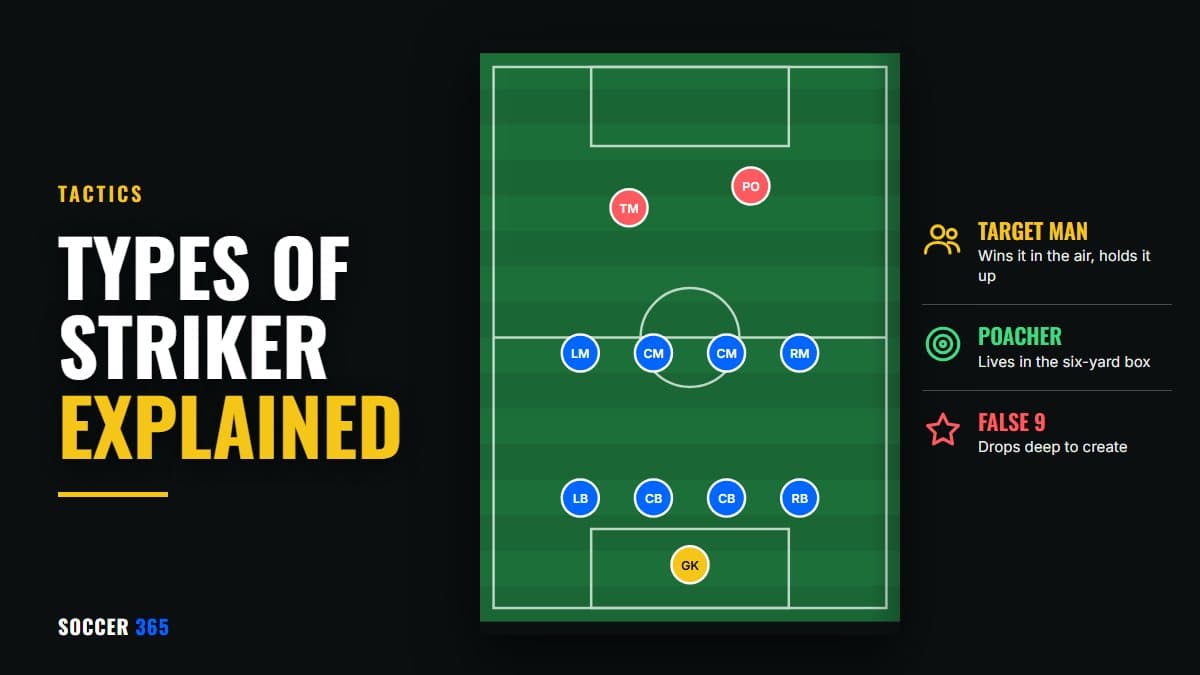
There are four main types of striker: the target man, the poacher, the false 9 and the complete forward. The target man wins the ball in the air and holds it up for others; the poacher finishes chances in the penalty area; the false 9 drops out of the forward line to create; and the complete forward can do all three.
Every one of them is still a centre-forward on the team sheet. What separates them is where they spend the game and what the rest of the team is built to give them.
The four types at a glance
| Type | Where he plays | Main job | Key traits | Defined by |
|---|---|---|---|---|
| Target man | Up against the centre-backs | Win long balls and crosses, hold the ball up | Height, strength, heading, first touch | Peter Crouch |
| Poacher | Inside the penalty area, on the last defender's shoulder | Finish close-range chances | Movement, anticipation, finishing | Filippo Inzaghi |
| False 9 | Starts up front, drops into midfield | Pull centre-backs out, create for runners | Passing, vision, dribbling | Lionel Messi, Francesco Totti |
| Complete forward | Everywhere across the front | Score, hold up, create and press | A bit of everything | Robert Lewandowski, Harry Kane |
The target man
The target man is the reference point for the whole side. Goal kicks, long passes from defence and crosses are aimed at him, and he is expected to win them: heading the ball on to a team-mate, knocking it down to a midfielder arriving from deep, or controlling it and holding off a centre-back until support arrives.
That makes him valuable in two ways. He gives a team under pressure an outlet, a way to get up the pitch without passing through midfield. And he gives a crossing team a target who can beat defenders in the air.
Peter Crouch is the clearest example the Premier League has produced. He holds the Guinness World Record for the most Premier League headed goals, 53, scored for Liverpool, Tottenham, Portsmouth, Aston Villa, Southampton and Stoke City between 2002 and 2019.
The target man's limit is that his team can become predictable. If every attack ends with a high ball towards the same player, a side with two good aerial centre-backs can take away its main route to goal.
The poacher
The poacher does little of the build-up. He is judged on one thing: turning the chances that fall to him in the penalty area into goals. His game is movement rather than touch, drifting between centre-backs, reading where a cross, a rebound or a loose ball will land, and getting there first.
He usually plays on the shoulder of the last defender, which is why good poachers are also judged on how rarely they are caught offside; the rule they spend their whole career testing is set out in offside explained simply.
Filippo Inzaghi is the archetype. In the 2007 Champions League final in Athens, he scored both of Milan's goals in a 2-1 win over Liverpool. The first was pure poacher's instinct: Andrea Pirlo's free-kick struck him and deflected in on the stroke of half-time. The second came from a Kaká pass, finished past Pepe Reina.
Erling Haaland has brought the penalty-box striker back to the top of the game. In his first season at Manchester City, 2022-23, he scored 36 Premier League goals, a record for the competition. The old mark of 34, shared by Andrew Cole and Alan Shearer, had been set in 42-game seasons; Haaland also became the first player to pass 35 goals in an English top-flight season since Ron Davies in 1966-67.
The poacher's weakness is the rest of the game. A striker who rarely drops off to link play gives his team one fewer passing option, and when chances dry up, he can disappear from a match altogether.
The false 9
The false 9 starts in the centre-forward position and then leaves it. He drops into midfield to collect the ball, which leaves the opposing centre-backs with an awkward choice: follow him and open a gap behind them, or hold their line and let him turn unmarked in front of them. Either way, his team-mates, often wide forwards or midfielders, run into the space he has emptied.
Francesco Totti at Roma is the side most often credited with reviving the role. Luciano Spalletti, with his squad hit by injuries, pushed Totti up front with no conventional striker ahead of him and let him drop deep, a shape so fluid that it has been described as a 4-6-0. In 2006-07 Totti scored 26 Serie A goals and won the European Golden Boot, one goal ahead of Real Madrid's Ruud van Nistelrooy.
Lionel Messi made the role famous. Pep Guardiola first used him there in Barcelona's 6-2 win at Real Madrid on 2 May 2009. Messi started on the right, swapped places with Samuel Eto'o around seven minutes in, and spent the rest of the game dropping into the space in front of Madrid's centre-backs, with Eto'o and Thierry Henry running in behind from wide. He scored twice and made another.
A false 9 needs a particular team around him. Without forwards or midfielders willing to run into the space he creates, he simply becomes an extra midfielder and the side has nobody in the box.
The complete forward
The complete forward can do each of the other three jobs well enough to switch between them in a single game: win a header, hold the ball up with his back to goal, score from six yards, drop deep to play a pass, and lead the press on the opposing centre-backs. It is the rarest type, because so few players are good at all of it.
Robert Lewandowski is the benchmark. In 2020-21 he scored 41 Bundesliga goals, breaking the record of 40 that Gerd Müller had set in 1971-72, and did it in 29 of Bayern Munich's 34 league games. The 41st came in the last minute of the season, in a 5-2 win over Augsburg. "I never dreamt about breaking this record, to score more than 40 goals because I thought that it's impossible," he said afterwards.
Harry Kane is the other obvious modern case: a striker who scores in every way and also creates for others. In his debut Bundesliga season, 2023-24, he scored 36 goals and made eight more in 32 appearances, winning the European Golden Shoe. He then became the first player in Bundesliga history to finish top scorer in each of his first three seasons, and reached 100 Bundesliga goals in 98 games, against a previous record of 129.
How they pair up
With a single striker, a coach picks the type that suits the team. With two, the classic answer is a complementary pair, one who comes short and one who runs in behind, and the most traditional version of that is the target man and the poacher: one wins the ball in the air, the other feeds on the knock-downs.
Three-at-the-back systems often keep two strikers for the same reason; Inter's partnership in our 3-5-2 guide works on the same principle of one linking and one running. A lone-striker shape such as the 4-2-3-1 asks more of one player, which is why it tends to favour a complete forward or a target man who can hold the ball up while the three attacking midfielders arrive.
Which type does a team need?
| If the team... | The striker that fits | Why |
|---|---|---|
| Plays direct or crosses a lot | Target man | Gives long passes and crosses someone to aim at |
| Creates many close-range chances | Poacher | Turns volume in the box into goals |
| Dominates possession against deep defences | False 9 | Adds a player in midfield and drags centre-backs out of position |
| Wants one striker to do everything | Complete forward | Covers holding up, finishing, creating and pressing |
| Plays two up front | Target man with a poacher, or any short-and-long pair | Each covers the other's weakness |
Other labels you will hear
The four types above are the ones most often described, but coaches and analysts use finer labels too. A pressing forward is picked mainly for his work without the ball, closing down centre-backs and cutting passing lanes. A deep-lying forward drops to link play like a false 9 but keeps a more conventional striker's position. And a second striker plays just off a centre-forward in a front two, quicker and more technical than his partner.
Most real strikers are a mix of more than one type. The labels are most useful for describing what a team is asking its No.9 to do in a given system, rather than for boxing in a player for a whole career.
Frequently Asked Questions
What are the main types of striker in football?
Four are most commonly described: the target man, a tall, strong striker who wins headers and holds the ball up; the poacher, who lives in the penalty area and scores from close range; the false 9, who starts as the centre-forward but drops into midfield; and the complete forward, who can do all of those jobs.
What is the difference between a target man and a poacher?
A target man is a reference point for the whole team: long passes and crosses are aimed at him, and he wins them, holds them or knocks them down for others. A poacher does little outside the penalty area and is judged almost entirely on finishing the chances that fall to him.
What does a false 9 do?
A false 9 starts in the centre-forward position and then drops deep into midfield. The opposing centre-backs must either follow him and leave space behind, or stay and let him receive the ball unmarked, and his team-mates run into whichever gap appears.
Who was the first false 9?
The idea is older than the modern label, but two sides are usually credited with reviving it: Luciano Spalletti's Roma, with Francesco Totti dropping off from centre-forward in the mid-2000s, and Pep Guardiola's Barcelona, who first used Lionel Messi there in their 6-2 win at Real Madrid on 2 May 2009.
What is a complete forward?
A striker who can play as a target man, a poacher and a creator in the same match: winning headers, holding the ball up, finishing in the box, dropping deep to pass and pressing defenders. Robert Lewandowski and Harry Kane are the standard modern examples.
Which type of striker is best?
None in isolation. The right type depends on the team's style: a side that plays direct or crosses a lot needs a target man, a side that creates many close-range chances rewards a poacher, and a possession side that wants an extra midfielder may pick a false 9.