
Full-Back vs Wing-Back vs Inverted Full-Back: The Differences Explained
Three wide defenders, three different jobs. Where a full-back, a wing-back and an inverted full-back stand, drawn out, and why the same player can be all three.
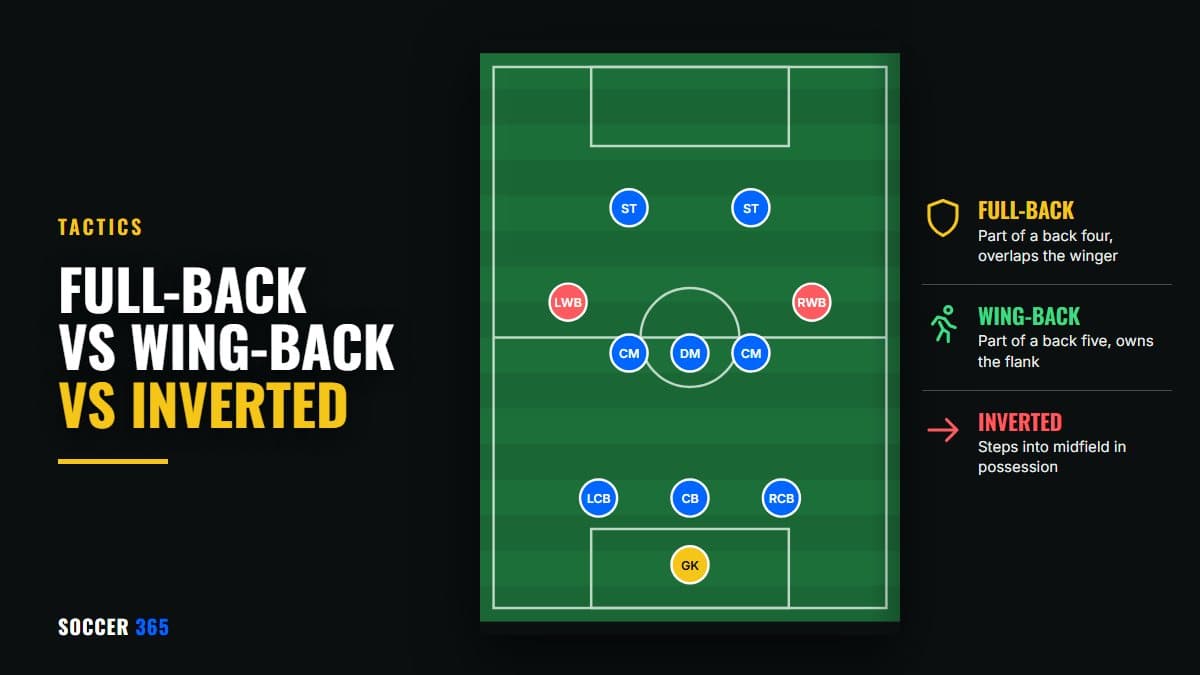
A full-back defends on the flank of a back four, a wing-back patrols the whole flank in front of a back three, and an inverted full-back defends like a full-back but moves into central midfield when his team has the ball. All three start in the same wide area of the pitch. What separates them is the shape around them and where they go once the ball is won.
The same player can move between them. Trent Alexander-Arnold broke into Liverpool's side as an overlapping right-back and later became one of the best-known inverted full-backs in the Premier League. To see why that matters, it helps to take each role in turn.
The three roles at a glance
| Full-back | Wing-back | Inverted full-back | |
|---|---|---|---|
| Back line without the ball | Back four | Back five | Back four |
| Typical formations | 4-4-2, 4-3-3, 4-2-3-1 | 3-5-2, 3-4-3, 3-4-1-2 | 4-3-3, 4-2-3-1 |
| Where he goes with the ball | Up the touchline, outside or inside the winger | High and wide, often in the front line | Inside, into central midfield |
| Who provides width | Shared with the winger | Almost always the wing-back | The winger |
| Main physical demand | Repeated sprints up and down one flank | Covering the entire flank for 90 minutes | Positional discipline and quick recovery |
| Key technical skill | Crossing, one-against-one defending | Crossing from deep and the byline | Passing and receiving under pressure |
| Defining examples | Nílton and Djalma Santos, Robertson, Alba | Moses and Alonso at Chelsea, 2016-17 | Lahm at Bayern, Cancelo, Zinchenko, Alexander-Arnold |
The full-back
The name comes from the 2-3-5 of the early 20th century, in which the full-backs were the deepest players on the pitch. As Coaches' Voice explains, once the back four took over, the full-backs moved out to the sides. Brazil's 1958 World Cup winners were an early exception to the defensive stereotype, with Nílton Santos and Djalma Santos both willing to attack.
Without the ball a full-back defends the space outside his centre-back, deals with the opposing winger one-against-one, cuts off balls down the line and chases back when possession is lost. In a pressing side he also jumps out to close down the opposing full-back.
With the ball the modern full-back's job is to join attacks with two kinds of run. An overlap goes round the outside of the winger in front of him; an underlap goes up the inside. Either one gives the team a two-against-one against the opposing full-back, the most common overload in wide areas. From there he crosses, cuts the ball back or switches play. When the winger in front comes inside, the full-back becomes the team's width.
Liverpool's full-backs under Jürgen Klopp set the modern benchmark for attacking output. Alexander-Arnold set the record for assists by a defender in a single Premier League season with 12 in 2018-19, then broke it with 13 in 2019-20, the 13th coming in a 5-3 win over Chelsea. On the other side, Andy Robertson was the Premier League's all-time leader for assists by a defender until Alexander-Arnold passed him in a 3-1 win over Burnley in February 2024.
| Most Premier League assists by a defender (to 10 Feb 2024) | Assists |
|---|---|
| Trent Alexander-Arnold | 58 |
| Andrew Robertson | 57 |
| Leighton Baines | 53 |
| Graeme Le Saux | 44 |
| Antonio Valencia | 39 |
By May 2025, according to the Premier League, Alexander-Arnold had 64 and Robertson 59.
The wing-back
A wing-back is the wide player in a formation with three centre-backs. Coaches' Voice describes the role as a hybrid of defender and midfielder, and the word itself as a blend of full-back and winger. It traces the back five to Helenio Herrera's Inter in the 1960s and the more attacking version of the role to Carlos Bilardo's Argentina in the 1980s.
The important difference from a full-back is the third centre-back behind him. That extra cover lets a wing-back play higher and wider, and it means he almost always supplies his team's width, because nobody else in the side stands on the touchline. Full-backs only sometimes do.
With the ball wing-backs stretch the pitch, cross from deep or from near the byline, and in some systems attack in a front line of five. Increasingly they also take part in wide rotations, moving infield while a wide centre-back or midfielder goes outside them.
Without the ball they drop either side of the centre-backs to make a back five and block crosses. Because three centre-backs are covering the middle, a wing-back can leave the line to engage the ball more freely than a full-back can. In a high press, he may push right up to the opposing full-back.
The cost is distance. A wing-back covers the whole flank, so when the ball is lost the run back is long, and the space he leaves is where opponents counter-attack. That is the weakness our 3-5-2 guide describes from the other side.
The most famous recent example came at Chelsea in 2016-17. After a 3-0 defeat at Arsenal in September 2016, Antonio Conte switched to a back three, with Victor Moses and Marcos Alonso as wing-backs. Moses had been a winger. Chelsea then won 13 league games in a row and clinched the title at West Brom on 12 May 2017. Converting wingers is a common route into the role: Coaches' Voice lists Ashley Young, Juan Cuadrado, Jesús Navas and Ivan Perišić alongside Moses.
The inverted full-back
An inverted full-back starts as a normal full-back in a back four. The Premier League defines the role simply: full-backs who move inside into central spaces when their team has the ball. Without the ball, he defends in the usual wide position.
The point is numbers in the middle. When one or both full-backs come inside during build-up, the team gains an extra central midfielder, the midfielders in front can push higher, and the attackers can follow them. The winger keeps the width, and if the opposing winger follows the full-back inside, the winger is left one-against-one with a defender.
Guardiola made this a regular part of build-up play at Bayern Munich with Philipp Lahm and David Alaba, and took it to Manchester City with players such as João Cancelo and Kyle Walker. He was not the first coach to do it, though. Coaches' Voice notes that Johan Cruyff's Barcelona would sometimes turn their 4-3-3 into a 3-4-3 diamond by moving one full-back into midfield, with Guardiola playing as the single pivot.
By November 2023 the Premier League reported that Mikel Arteta, Jürgen Klopp, Ange Postecoglou, Roberto De Zerbi and, at times, Erik ten Hag were all inverting their full-backs. At Arsenal, Oleksandr Zinchenko was the player who stepped into midfield, and Myles Lewis-Skelly took over the role in 2024-25.
How Liverpool used it
Alexander-Arnold's move came against league leaders Arsenal at Anfield on 9 April 2023. Liverpool were 2-0 down and drew 2-2, with Alexander-Arnold stepping into midfield beside Fabinho in possession to make a 3-2-2-3. "In the build-up, Trent played more inside. Double six, that's how it is," Klopp said afterwards.
Liverpool won their next seven games, and according to Goal Alexander-Arnold had seven assists in the last ten league games of the season after two before the switch. He said of it: "I felt I could dictate and control from right-back, but this was another dimension to my game."
Inverted full-back or stepping centre-back?
Guardiola has since got the same midfield numbers a different way. Instead of a full-back coming inside, a centre-back steps up beside the holding midfielder: John Stones, Fernandinho and Manuel Akanji have all played alongside Rodri in the build-up at City. The result looks similar on the pitch, a back three behind a double pivot, but the player stepping out is a defender used to central areas, not one used to the touchline.
Strengths and weaknesses compared
| Role | Strengths | Weaknesses |
|---|---|---|
| Full-back | Balanced; creates wide two-against-ones with the winger; four defenders behind the ball when the full-backs hold position | When both push on, the space behind them is open to switches of play |
| Wing-back | Width on both flanks without wingers; five defenders without the ball; freedom to jump out of the line | Long recovery runs; gaps left out wide; very high physical load; fewer players in midfield and attack |
| Inverted full-back | Extra central midfielder in build-up; better counter-pressing in the middle; isolates the winger one-against-one | One fewer player in the last line on transitions; needs a rare player who can defend wide and pass like a midfielder |
The Coaches' Voice summary of the inverted role's main drawback is blunt: it needs players who can defend in wide areas but also handle the ball like a central midfielder, and when the ball is lost there is one fewer player in the last line of defence.
Why a coach chooses one over another
Full-backs suit a back four with wingers who stay wide or come inside, the shape of a 4-2-3-1 or a 4-4-2. The double pivot in a 4-2-3-1 in particular is what lets both full-backs attack at once.
Wing-backs suit a squad with three good centre-backs, a shortage of wingers and two wide players fit enough to run the flank all game. They also suit a side that expects to spend long spells without the ball, because the back five forms without any change of personnel.
Inverted full-backs suit a possession side that wants to control the middle during build-up and has wingers good enough to win one-against-ones.
The roles are not as separate as the labels suggest. A wing-back can drift inside on a rotation, an inverted full-back still defends wide, and in a 3-4-3 a wide centre-back may overlap like a full-back. Formation data from 2023-24 shows how much the back four still dominates, though: after 12 rounds, 80.8 per cent of Premier League line-ups used one, and back-three line-ups were at their lowest share since 2016-17. That makes the full-back, overlapping or inverted, still the most common wide defender in the league.
Frequently Asked Questions
What is the difference between a full-back and a wing-back?
A full-back plays on either side of two centre-backs in a back four; a wing-back plays on either side of three centre-backs in a back five. Because a wing-back has an extra centre-back covering behind, he is usually the team's only source of width and plays higher up the pitch than a full-back.
What is an inverted full-back?
A full-back who defends in the normal wide position without the ball but moves inside into central midfield when his team has it. The aim is an extra player in the middle during build-up, usually leaving three defenders behind and two players in front of them.
Who invented the inverted full-back?
Pep Guardiola made it a regular part of build-up play, first with Philipp Lahm and David Alaba at Bayern Munich and later at Manchester City. Johan Cruyff's Barcelona had already turned their 4-3-3 into a 3-4-3 diamond at times by moving one full-back into midfield.
Which formations use wing-backs?
Formations with a back three, mainly the 3-5-2, the 3-4-3 and the 3-4-1-2. Without the ball the wing-backs drop either side of the three centre-backs to make a back five.
Is a wing-back more attacking than a full-back?
Usually, yes. With a third centre-back covering behind, a wing-back can play higher and almost always provides the team's width, whereas a full-back provides width only some of the time and has more defending to do on his own.
What is the main weakness of an inverted full-back?
Transitions. If the ball is lost while he is in midfield, there is one fewer player in the last line of defence, and the space he left out wide is open for a counter-attack until he gets back.