Stoppage Time Explained: Why Football Adds Extra Minutes
What the referee counts, why the board is a minimum and not a deadline, why added time got longer, and how it differs from extra time.
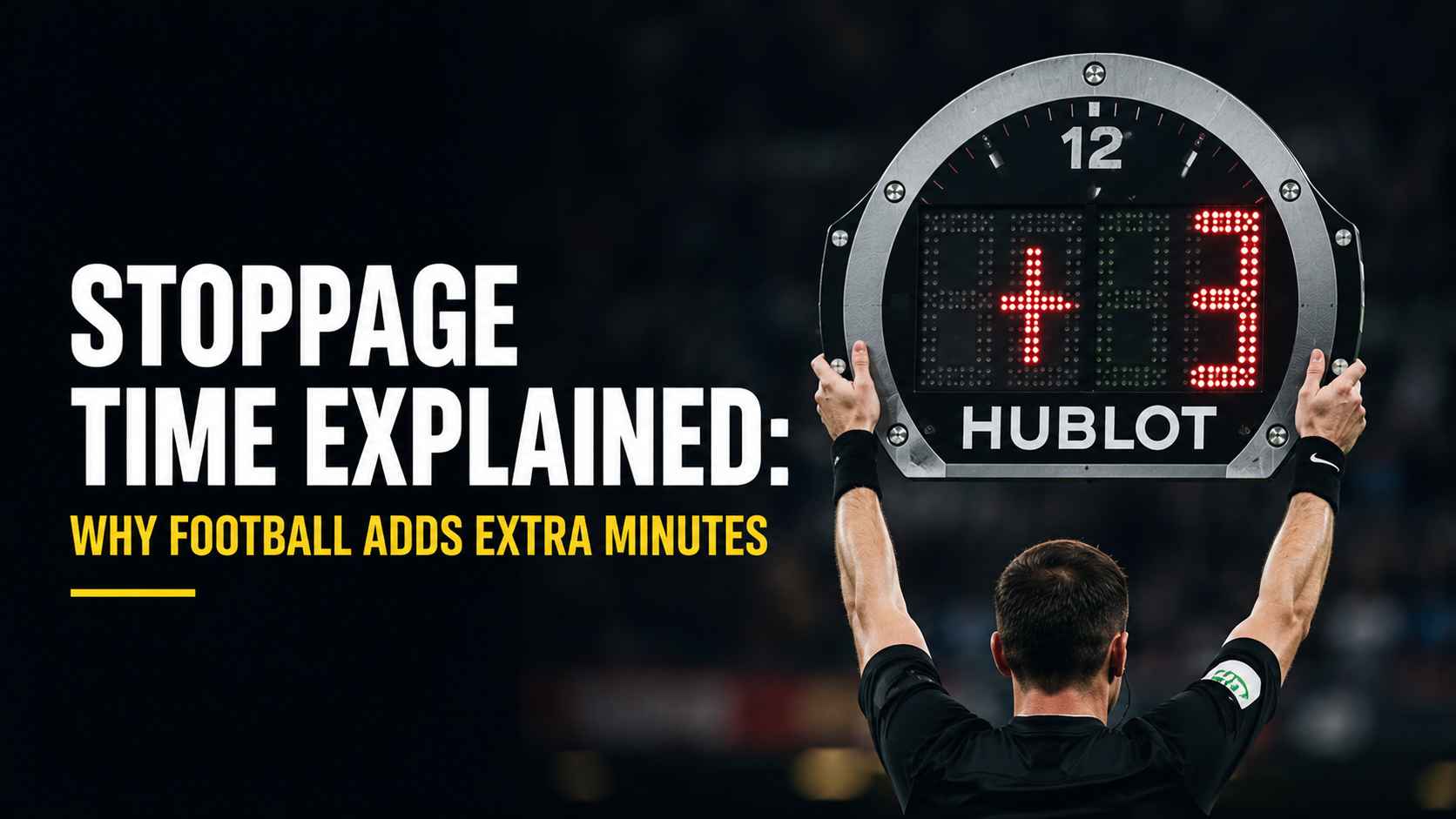
You've watched the clock hit 90 minutes and the match keeps going. A number appears on a board: +7. Here's where that number comes from, and why it's rarely the number you actually get.
The basic idea
A match is 90 minutes, split into two halves of 45. Unlike basketball or American football, the clock never stops. It runs continuously from kick-off, through injuries, substitutions and celebrations alike.
To compensate, the referee adds time at the end of each half for what was lost. That's stoppage time — the mechanism that turns 90 minutes of clock into something closer to 90 minutes of football.
What the referee counts
The Laws set out the categories of lost time the referee allows for:
- Substitutions — players leaving and entering the field.
- Injuries, and the time taken to assess and remove a player for treatment.
- Goal celebrations. These add up faster than people expect; several goals in a half is several minutes.
- Disciplinary sanctions — the process of issuing cards.
- VAR checks and reviews, including the time a referee spends at the monitor.
- Drinks and cooling breaks, where the competition uses them.
- Deliberate time-wasting, such as a slow goal kick or a substitute walking off at the far corner.
The referee is the only person tracking this, either mentally or on a watch, and the resulting figure isn't published, itemised or open to challenge.
The board is a minimum, not a deadline
This is what trips people up most. When the fourth official raises the board, that number is the referee's estimate at that moment, based on what has already happened.
The half does not end there. Anything that stops play during added time gets added to added time. A goal scored in the 92nd minute, celebrated for a minute, followed by a VAR check, can push a +4 well past +6.
So a manager complaining that "there were only supposed to be four minutes" is complaining about a rule that doesn't exist. The whistle goes when the referee judges the time has been played, not when the board's number expires.
The penalty exception
One rule genuinely overrides the clock. If a penalty is awarded at the end of a half, the half is extended until that kick is completed — no matter how long it takes.
Completed means resolved: the ball enters the goal, or the attempt clearly fails. If the kick has to be retaken, the extension continues. A half can end several minutes past everything on the board because a penalty was awarded in its final seconds.
This is also why a penalty is the only thing that can be taken after the whistle would otherwise have gone, and why VAR overturning a decision in the 90th minute can produce a goal in what looks like an impossible minute.
Why added time got so much longer
If you remember a lazy "two or three minutes" being standard, you're not imagining it. The change was deliberate.
Governing bodies instructed referees to count lost time far more accurately, and specifically to stop under-counting the obvious things: celebrations, substitutions, and the theatre of running down a clock while leading. The reasoning was that a supporter buys a ticket for 90 minutes of football and was routinely getting closer to 55 minutes of ball-in-play.
The result was immediately visible at major tournaments, where additions of eight, ten and occasionally more than twelve minutes became normal. The knock-on effects have been argued about ever since: more goals late in matches, and considerably more running for players already at the limit of a congested calendar.
The underlying problem is structural. Football measures a 90-minute match with a clock that doesn't reflect how much of it is actually played, and stoppage time is a manual correction applied by one person's judgement. Trials of a stopped clock — where the timer halts whenever the ball is out of play — have been run at various levels precisely because they'd remove the estimate entirely.
A worked example
Say the first half includes:
- A 3-minute injury stoppage
- Two substitutions, roughly 30 seconds each
- Two goals, celebrated for about a minute each
That's around 6 minutes lost, so the board shows +6, and the half runs into the 51st minute — unless something else happens during those six minutes, which then extends it further.
Stoppage time is not extra time
These get confused constantly, and they're completely separate things.
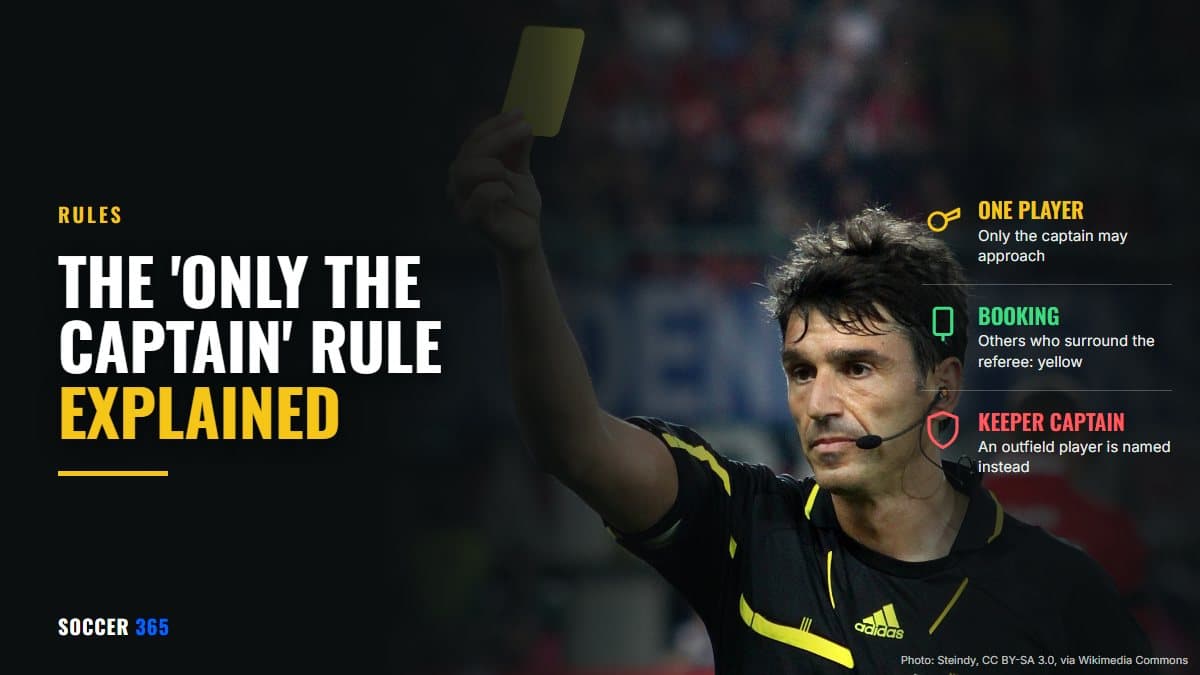
Stoppage time is added to the end of each half of a normal match. It's compensation for time lost. Every match has it.
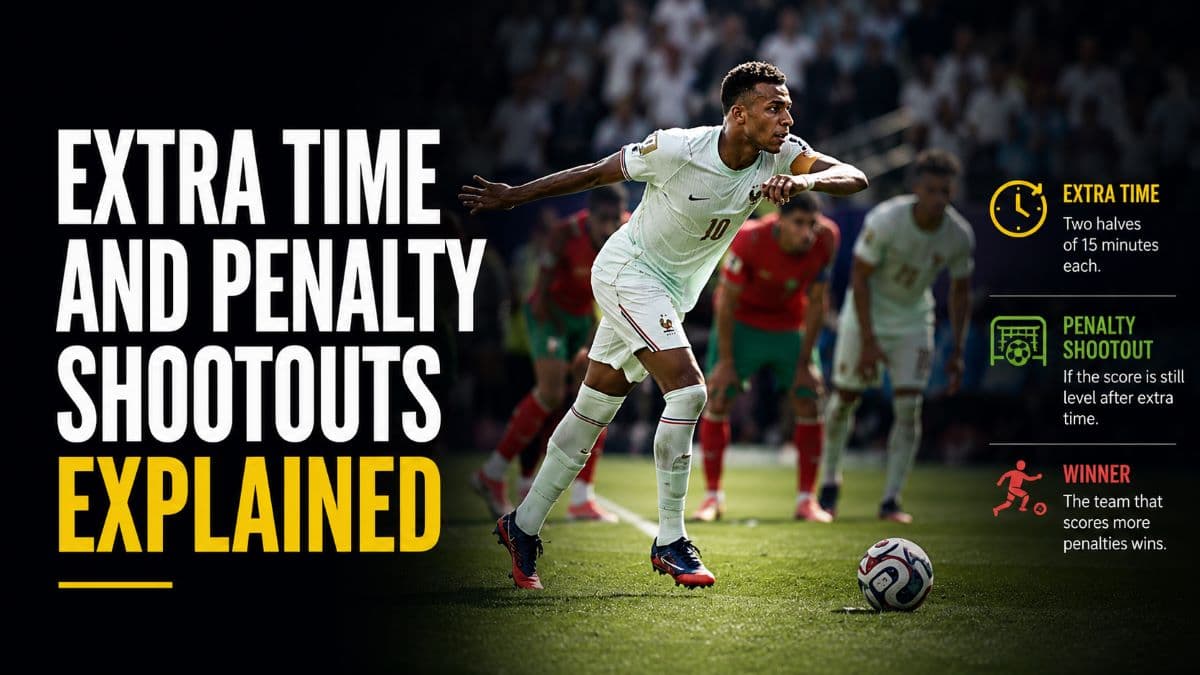
Extra time is an additional 30 minutes, two halves of 15, played only in a knockout match that is level after 90 minutes, where somebody has to progress. If the score is still level after extra time, the tie goes to a penalty shootout. Our guide to extra time and penalty shootouts covers how both work.
And yes: extra time has its own stoppage time, calculated the same way, added to each of its 15-minute halves. A knockout match can comfortably run past 130 minutes before a shootout even begins.
League matches don't use extra time. A draw is a draw, and both teams take a point — see how league tables and points work.
Where VAR fits in
VAR is one of the largest single contributors to modern stoppage time. Every check costs time, and a full on-field review costs several minutes.
That time is added back, which is why matches with multiple contentious incidents run so long. Our guide to how VAR works explains what the system is allowed to review and why some checks take far longer than others.
The short version
- The clock never stops, so time is added at the end of each half.
- The board is a minimum. More can always be added.
- A penalty at the end of a half extends it until the kick is finished.
- Referee's judgement, not appealable.
- Extra time is a different thing entirely — 30 minutes, knockouts only.
Frequently Asked Questions
What is stoppage time in football?
Extra time added to the end of each half to compensate for minutes lost to injuries, substitutions, goal celebrations, VAR checks and time-wasting. It is also called added time or injury time.
Who decides how much stoppage time is added?
The referee, and only the referee. The fourth official displays the figure but does not set it, and the decision cannot be appealed or overruled.
Can the match go longer than the number on the board?
Yes. The board shows a minimum. Anything that stops play after it goes up, including an injury, a VAR review or a goal celebration, gets added on top.
Can a half end while a penalty is being taken?
No. If a penalty is awarded at the end of a half, the half is extended until the kick has been completed, however long that takes. The kick has to reach its outcome before the whistle can go.
What is the difference between stoppage time and extra time?
Stoppage time is added to the end of each half of a normal 90-minute match. Extra time is a separate 30-minute period, split into two halves of 15, played only in knockout matches that are level after 90 minutes.
Why has stoppage time got so much longer?
Governing bodies instructed referees to count lost time far more precisely, particularly for goal celebrations, substitutions and deliberate delays. Additions of eight to twelve minutes, once rare, became routine as a result.
Is stoppage time added before half-time?
Added time is played at the end of each half, not before the interval. The first half's addition runs on from the 45th minute, and the second half's from the 90th.
Does extra time have stoppage time too?
Yes. Each 15-minute period of extra time has its own added time, calculated the same way.